Chaldean Numerology Table Explained (Letter by Letter)
If you’ve searched for a Chaldean Numerology Table Explained in plain, usable terms, you’ve probably noticed most resources either throw a chart at you with no context, or bury the explanation under so much mystical language that the actual logic gets lost. This guide takes a different approach. Every letter, every number group, and every exception in the Chaldean system is walked through here individually, so by the end you’ll be able to look at any name and work out its Chaldean values by hand — not just plug it into a calculator and hope for the best.
What Makes the Chaldean System Different in the First Place
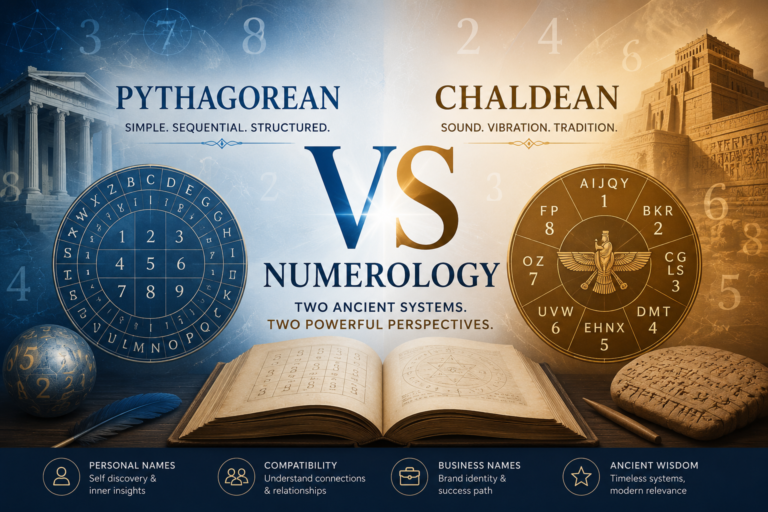
Before getting into the letter-by-letter breakdown, it helps to understand why the Chaldean chart looks the way it does. Unlike the Pythagorean system, which assigns numbers to letters in a simple repeating sequence based on alphabetical order, the Chaldean system groups letters according to their phonetic vibration — the sound quality of the letter itself, not where it happens to sit in the alphabet.
This is the single biggest thing to understand before working through any Chaldean Numerology Table Explained resource: you cannot predict a letter’s value just by counting its position in the alphabet the way you can with Pythagorean numerology. Each grouping in the Chaldean chart was assigned based on a much older, sound-based logic dating back to ancient Babylon, the historical region referred to as Chaldea. That’s also why the chart looks uneven — some numbers hold four or five letters, others hold only two or three.
The Complete Chaldean Letter-to-Number Chart
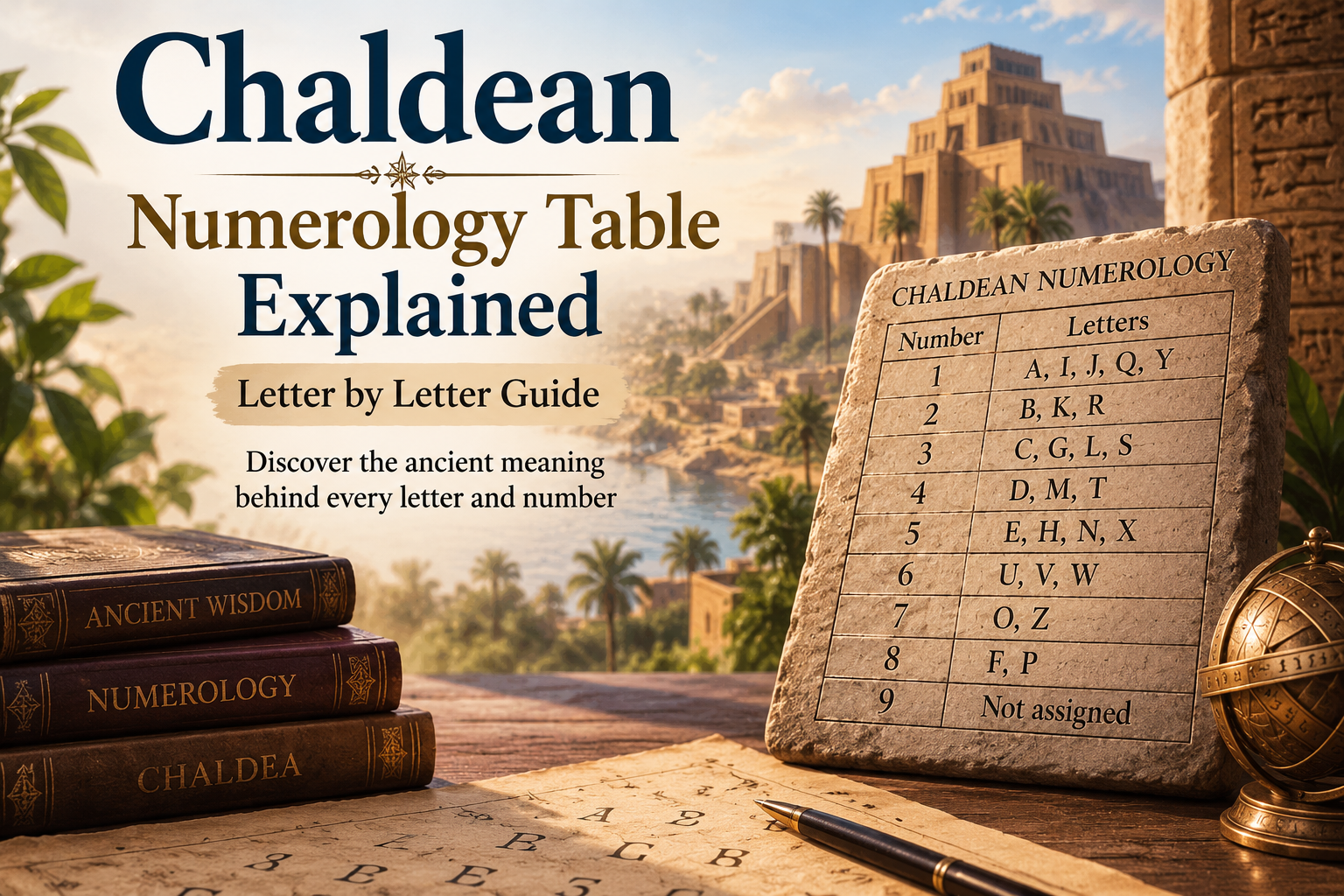
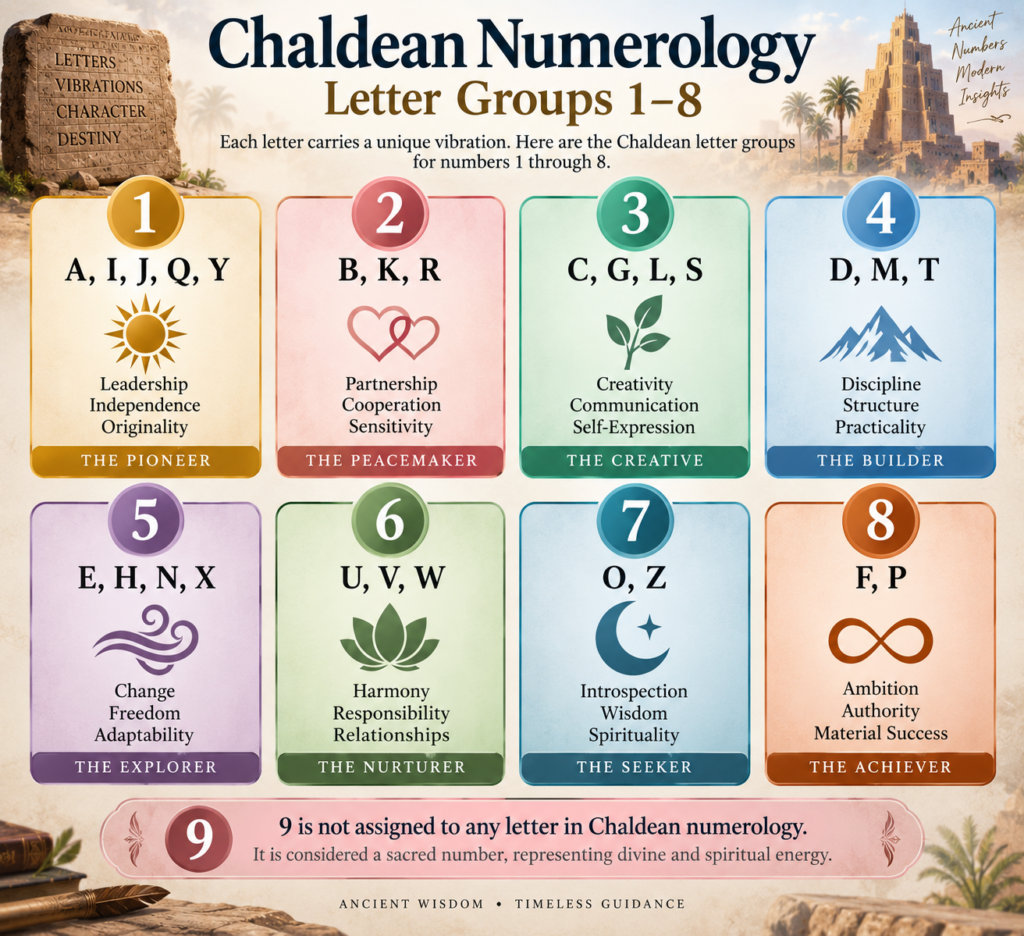
Here is the full breakdown, grouped by number, exactly as it’s used across most traditional Chaldean numerology resources:
| Number | Letters |
|---|---|
| 1 | A, I, J, Q, Y |
| 2 | B, K, R |
| 3 | C, G, L, S |
| 4 | D, M, T |
| 5 | E, H, N, X |
| 6 | U, V, W |
| 7 | O, Z |
| 8 | F, P |
| 9 | Not assigned to any letter |
This table is the core of any Chaldean Numerology Table Explained breakdown, and it’s worth studying closely, because almost every calculation in Chaldean numerology traces back to these nine rows.
Letter by Letter: Number 1 Group — A, I, J, Q, Y
The number 1 group includes A, I, J, Q, and Y. In Chaldean tradition, 1 is associated with leadership, independence, and a strong individual will. Because A is the first letter of the alphabet in both systems, people are sometimes surprised that other letters like J, Q, and Y share its value — this is a direct example of the sound-based logic at work rather than alphabetical placement.
Letter by Letter: Number 2 Group — B, K, R
B, K, and R fall under 2, a number traditionally linked with partnership, sensitivity, and cooperation. This is one of the smaller groupings in the chart, containing only three letters, which is part of what makes any Chaldean Numerology Table Explained resource emphasize how uneven the distribution really is compared to the clean, evenly spaced Pythagorean chart.
Letter by Letter: Number 3 Group — C, G, L, S
C, G, L, and S are grouped under 3, associated with communication, creativity, and self-expression. Four letters sit in this group, making it one of the more populated rows in the table.
Letter by Letter: Number 4 Group — D, M, T
D, M, and T fall under 4, a number tied to structure, discipline, and practical foundations. As with the 2 group, this row holds only three letters.
Letter by Letter: Number 5 Group — E, H, N, X
E, H, N, and X are grouped under 5, traditionally associated with change, movement, and adaptability. This group is worth remembering when working through a Chaldean Numerology Table Explained exercise by hand, since E is one of the most frequently occurring letters in English names, meaning it has an outsized influence on many name calculations.
Letter by Letter: Number 6 Group — U, V, W
U, V, and W sit under 6, linked with harmony, responsibility, and domestic or relational themes. This is the group most people check first when trying to identify whether a calculator is using Chaldean or Pythagorean logic, since U carries a different value in each system — 3 under Pythagorean rules, 6 under Chaldean rules.
Letter by Letter: Number 7 Group — O, Z
O and Z form one of the smallest groups in the entire chart, associated with introspection, wisdom, and a more solitary or thoughtful energy. Only two letters occupy this row.
Letter by Letter: Number 8 Group — F, P
F and P are grouped under 8, tied to material achievement, ambition, and authority. Like the 7 group, this row contains just two letters.
Why the Number 9 Is Left Out Entirely
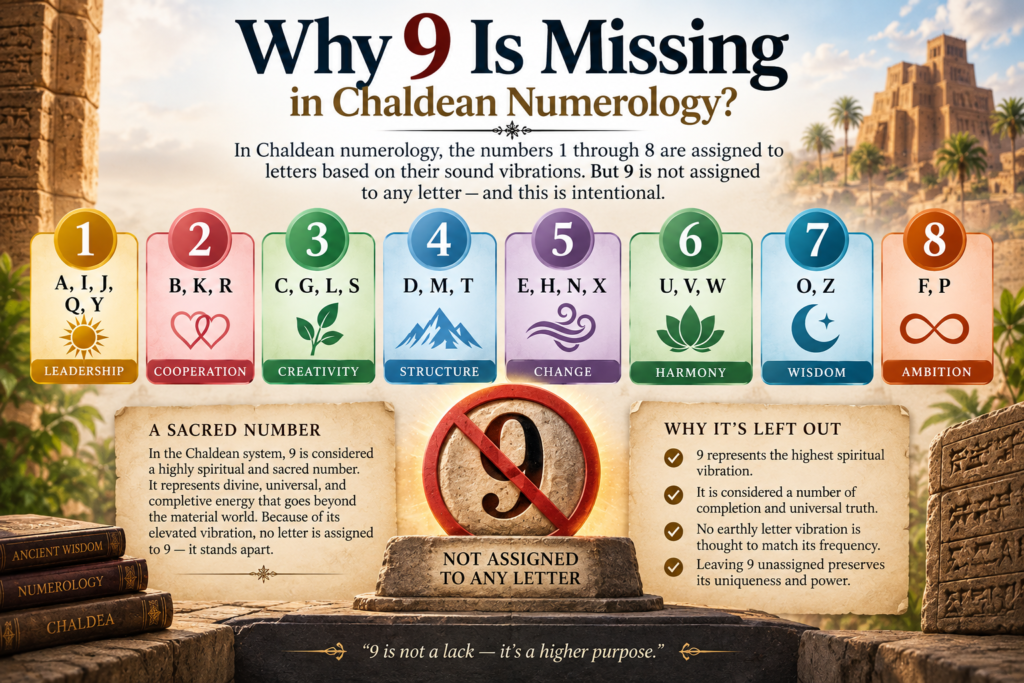
This is the detail that surprises people most when they first work through a Chaldean Numerology Table Explained breakdown: unlike every other digit from 1 to 8, the number 9 is never assigned to a letter at all. In Chaldean tradition, 9 is considered sacred, representing completion, universal wisdom, and a level of significance too great to permanently attach to any single letter.
That doesn’t mean 9 never appears in a Chaldean reading — it absolutely can show up as a final result once letter values are added together and reduced. It simply means 9 never appears as a starting letter value the way 1 through 8 do. This distinction is a common point of confusion, and it’s one of the clearest ways to tell whether a resource actually understands the system or is just repeating a chart without explaining the reasoning behind it.
How to Actually Use the Table on a Real Name
Once the letter groupings are clear, applying them to a name follows the same basic three steps used across most numerology systems:
- Write out the name and assign each letter its Chaldean value using the table above.
- Add all the values together to get a total.
- Reduce the total to a single digit by adding its digits together, unless the total is a master number like 11, 22, or 33, in which case it’s typically left as-is.
Along the way, you’ll often pass through what’s called a compound number — the two-digit total before the final reduction. Many traditional Chaldean readings pay attention to this compound number specifically, not just the final single digit, since it’s believed to carry its own layer of meaning separate from the reduced result.
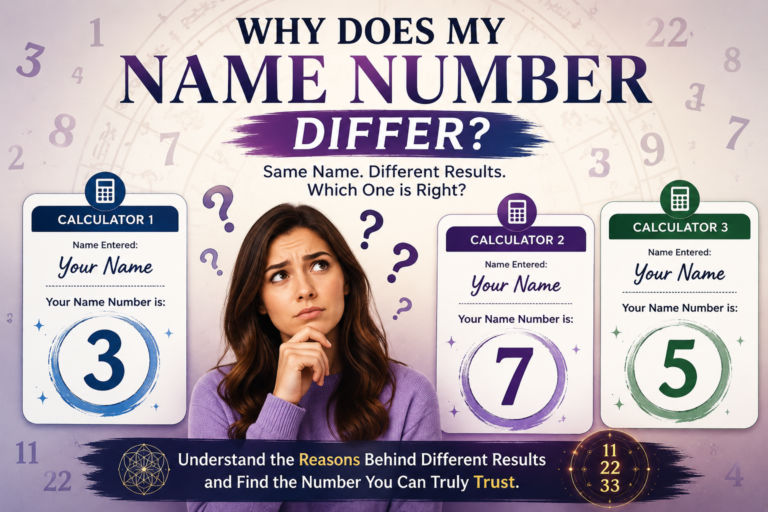
If you’re comparing your Chaldean result against a Pythagorean one for the same name, don’t expect them to match. Name Number Differs walks through exactly why that happens across different calculators, and it’s worth reading alongside this table if your results ever seem inconsistent from one site to another.
A Worked Example: Calculating a Name by Hand
The clearest way to see this Chaldean Numerology Table Explained breakdown in action is to actually run a name through it. Take the name “MAYA” as a simple example.
Using the chart above: M is 4, A is 1, Y is 1, and A is 1 again. Adding those together gives 4 + 1 + 1 + 1 = 7. Since 7 is already a single digit, no further reduction is needed — the Chaldean value for “MAYA” is 7, associated with introspection and independent thinking under Chaldean tradition.
Now compare that to a longer name, “DANIEL.” D is 4, A is 1, N is 5, I is 1, E is 5, and L is 3. Adding those values gives 4 + 1 + 5 + 1 + 5 + 3 = 19. That two-digit total, 19, is the compound number mentioned earlier — and reducing it further (1 + 9) brings the final single-digit result down to 1.
Running through examples like this by hand is really the fastest way to internalize a Chaldean Numerology Table Explained guide instead of just reading the chart passively. Once you’ve calculated two or three names manually, the letter groupings start to stick without much conscious memorization at all.
Chaldean vs. Pythagorean: A Quick Reference
While this guide focuses specifically on the Chaldean side, it helps to see the contrast laid out directly:
| Factor | Chaldean | Pythagorean |
|---|---|---|
| Basis for letter assignment | Sound vibration | Alphabetical sequence |
| Number 9 | Excluded from the chart | Included like any other number |
| Grouping pattern | Uneven (2–5 letters per number) | Even (9 letters per cycle) |
| Historical origin | Ancient Babylon | Ancient Greece |
| Common regional use | South Asia, Vedic-influenced practice | Western numerology apps and books |
Keeping a Chaldean Numerology Table Explained reference like this one nearby makes it much easier to catch the difference at a glance rather than memorizing two separate systems from scratch.
Common Mistakes People Make With the Chaldean Table
A few errors come up repeatedly when people first start working with this system:
- Assuming U is 3, not 6. This is a Pythagorean value, not a Chaldean one — a frequent mix-up since so many online resources default to Pythagorean without saying so.
- Forgetting that 9 isn’t assigned to any letter. Some people try to force a letter into the 9 row when working from memory, which throws off the entire calculation.
- Skipping the compound number. Jumping straight to the final reduced digit skips a layer of meaning that traditional Chaldean readings often include.
- Mixing Chaldean and Pythagorean values in the same calculation. Since several letters carry different values across the two systems, blending them by accident produces a result that belongs to neither system.
Avoiding these four mistakes is really the difference between a rough guess and an accurate reading, and it’s exactly what a proper Chaldean Numerology Table Explained resource should help you avoid.
Frequently Asked Questions
Why does the Chaldean table look so uneven compared to Pythagorean numerology?
Because Chaldean numerology groups letters by sound rather than alphabetical order, some number groups naturally end up larger than others. This is a deliberate feature of the system, not an inconsistency or error.
Is the Chaldean system older than the Pythagorean system?
Yes. Chaldean numerology traces back to ancient Babylon, predating the Pythagorean method, which is credited to the Greek mathematician Pythagoras and his followers.
Do I need to memorize the whole table to use it?
Not necessarily. Many people keep a written copy of the table on hand while calculating a name by hand, similar to using a reference sheet rather than committing every group to memory upfront.
Can I use this table for business or brand names too?
Yes — the Chaldean system has historically been applied to business and brand names specifically, in addition to personal names, so the same letter groupings apply either way.
What should I do if my result doesn’t match a calculator I’ve used before?
Double-check that the calculator is actually using Chaldean logic and not Pythagorean, since the two systems assign different values to several letters. The U-check (3 under Pythagorean, 6 under Chaldean) is usually the fastest way to confirm which system a given tool is running.
Final Thought
A Chaldean Numerology Table Explained properly isn’t just a chart to memorize — it’s a system built on a completely different logic than most people expect going in, grouped by sound rather than sequence, with the number 9 deliberately set apart from the rest. Once each letter group and the reasoning behind it makes sense, working through any name by hand becomes a straightforward, repeatable process rather than something that has to be taken on faith from a calculator.