Baby Naming with Numerology: A Complete Step-by-Step Guide
Choosing a name is one of the first real decisions a parent makes for a child, and for many families, that decision goes beyond how a name sounds or what it means historically. Baby Naming with Numerology in mind adds another layer to the process checking whether the letters in a name add up to a number that complements the date a baby was born, rather than picking a name purely on style or family tradition.
This guide walks through the entire process from start to finish, covering how numbers are calculated, what they’re checked against, and how to actually narrow down a shortlist of names using this method without needing prior numerology experience.
Why Parents Consider Numerology When Naming a Baby
Baby Naming with Numerology isn’t a new practice it draws on traditions that go back centuries, particularly within Vedic and Chaldean numerology systems, where a name was historically treated as something that could either support or work against a person’s underlying nature. The core idea is straightforward: your birth date produces a life path number that stays fixed for life, while your name produces a separate number — called an expression number or destiny number built entirely from its letters. When these two numbers are considered together, some parents use the relationship between them as one more factor in choosing a name they feel good about.
It’s worth being clear from the outset that this isn’t a scientific or predictive process. It’s an interpretive tradition, similar to checking a name’s meaning in a baby name book, just working with numbers instead of etymology. Many families treat it as one input among several — alongside family names, meaning, sound, and cultural fit — rather than the single deciding factor.
Step 1: Calculate the Baby’s Life Path Number From the Birth Date
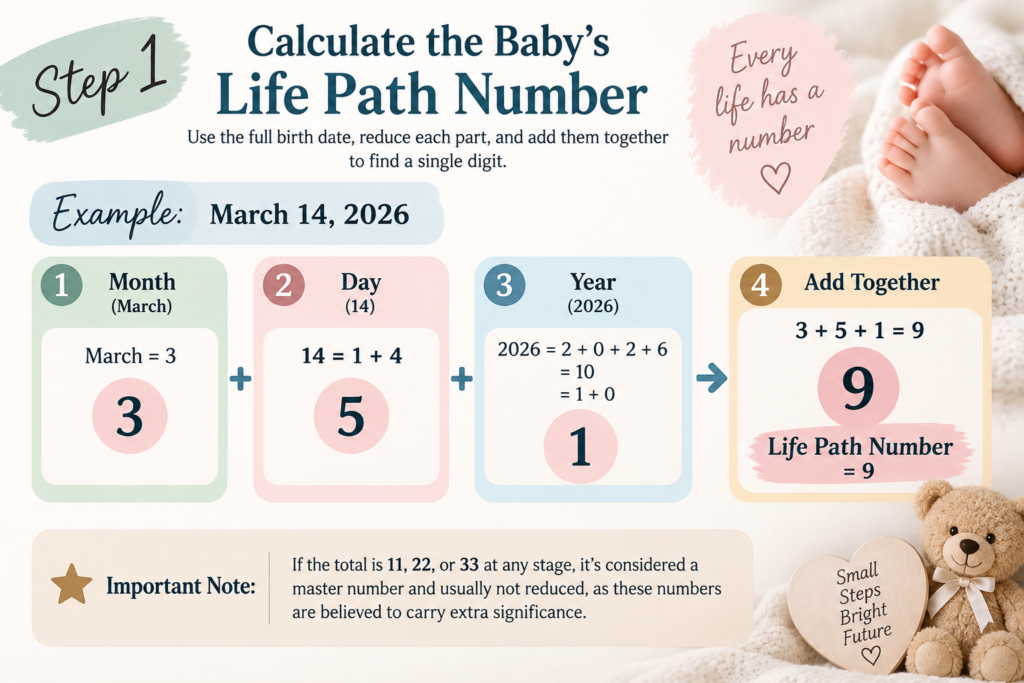
Before looking at any name at all, the first step in Baby Naming with Numerology is working out the baby’s life path number, since every other number in the process gets compared against this one.
To calculate it, write out the full birth date numerically, then reduce each part — day, month, and year — down individually before adding them together and reducing the total to a single digit. For example, a baby born on March 14, 2026 would work through it like this: March is month 3, the day is 14 (which reduces to 1 + 4 = 5), and the year 2026 reduces to 2 + 0 + 2 + 6 = 10, which reduces again to 1. Adding 3 + 5 + 1 gives 9, so the life path number in this example is 9.
If the total lands on 11, 22, or 33 at any stage, it’s typically treated as a master number and left unreduced, since these numbers are considered to carry more intensity than a standard single digit.
Step 2: Build a Shortlist of Names You Already Like
This step has nothing to do with numbers yet, and that’s intentional. Before layering numerology onto the process, it helps to have five or six name candidates chosen based on sound, meaning, family relevance, and how the name pairs with the family surname. Trying to reverse-engineer a name purely from a target number tends to produce awkward, forced-sounding results, so most people doing Baby Naming with Numerology properly start with names they’d be happy with regardless of what the numbers say.
Step 3: Choose Which Letter System You’ll Use
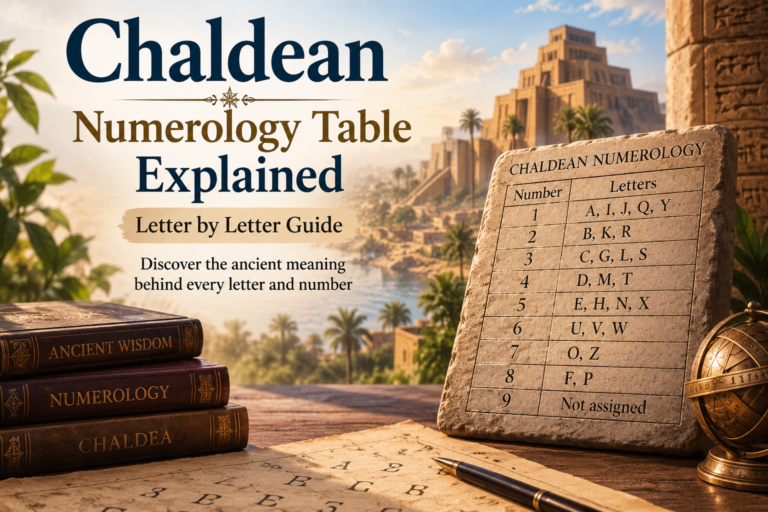
Before calculating anything, decide whether you’re working with Pythagorean numerology or Chaldean numerology, since the two systems assign different values to several letters and will produce different results for the same name.
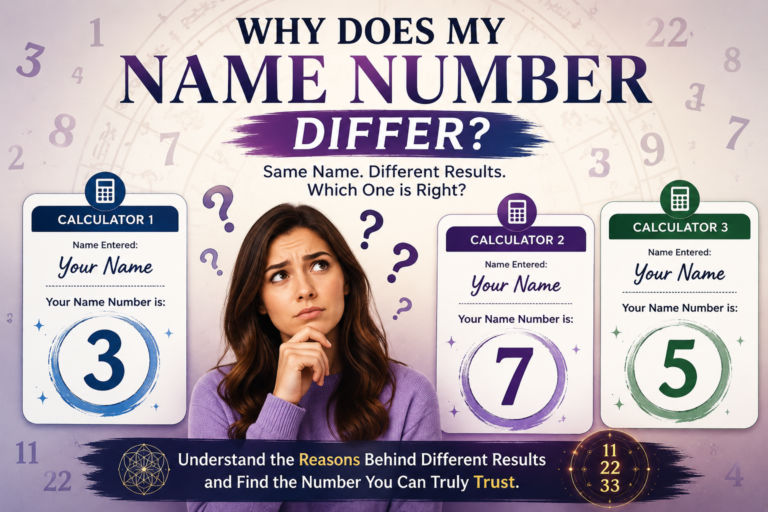
Pythagorean numerology assigns numbers 1 through 9 to the alphabet in a simple repeating sequence, and it’s the more common default across Western baby-naming resources because it’s easy to double-check by hand. Chaldean numerology, which is older and rooted in ancient Babylonian tradition, groups letters by sound rather than alphabet position, and is more commonly used in Vedic-influenced numerology practice. Neither is more “correct” than the other — but mixing the two by accident is the single most common mistake people make when trying Baby Naming with Numerology for the first time, so pick one system and stay consistent with it through the rest of the process.
Step 4: Calculate the Expression Number for Each Shortlisted Name
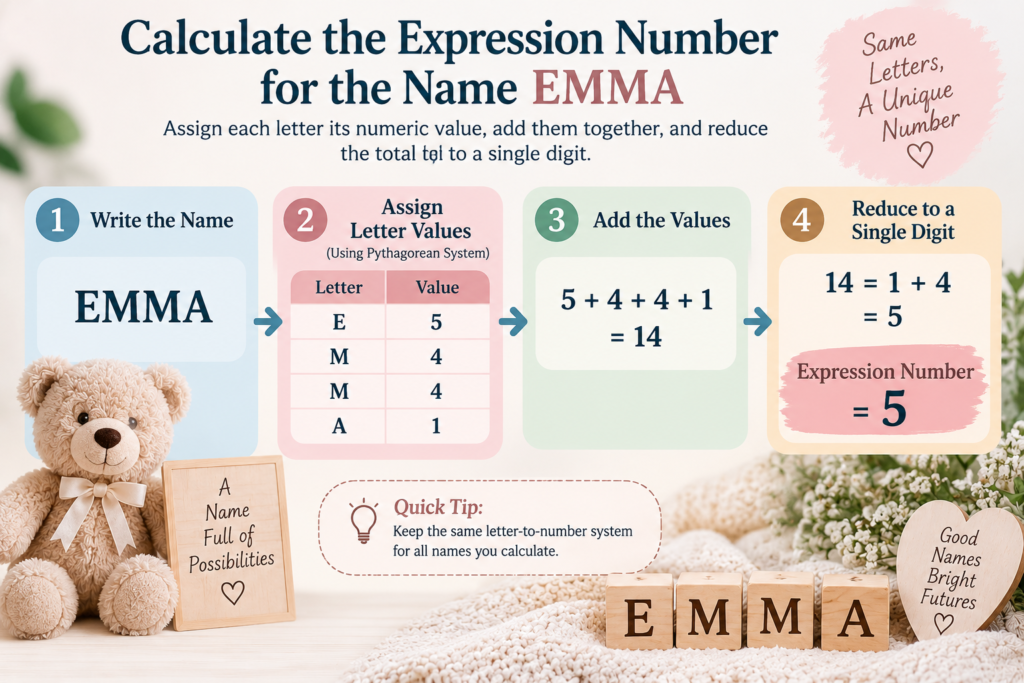
With a letter system chosen, work through each name on your shortlist the same way: assign each letter its numeric value, add the values together, and reduce the total to a single digit (unless it’s a master number).
For example, using Pythagorean values, the name “EMMA” breaks down as E=5, M=4, M=4, A=1, adding up to 14, which reduces to 5. This resulting number is the expression number — sometimes called the destiny number — and it’s the core figure used throughout the rest of this Baby Naming with Numerology process.
Do this for every name on your shortlist before moving to the next step, so you have a clear list of names paired with their corresponding numbers.
Step 5: Compare Each Name’s Number Against the Life Path Number
This is the step most people associate with Baby Naming with Numerology — checking how a name’s expression number relates to the life path number calculated in Step 1.
There’s no single universal rule for what counts as a “good match,” since different numerology traditions frame compatibility slightly differently. That said, a few general patterns show up consistently across most resources:
- A matching or identical number is often considered reinforcing, doubling down on the qualities already present in the life path number.
- Numbers that are traditionally considered complementary to each other (for instance, 1 and 5, or 2 and 6, depending on the tradition you’re following) are often viewed as balancing, adding qualities the life path number doesn’t inherently have.
- A name number that clashes with a life path number under a given tradition’s compatibility rules isn’t treated as disqualifying by most practitioners, but it’s often flagged as worth a second look.
If you’re working from a specific numerology book or resource, it will usually include its own compatibility chart — it’s worth sticking to one consistent source rather than mixing compatibility rules from multiple traditions partway through.
Step 6: Consider the Sound and Meaning Alongside the Number
A name’s numerological value is only one input, and treating it as the only one tends to produce a shortlist that looks good on paper but doesn’t actually feel right when spoken aloud every day. At this stage in Baby Naming with Numerology, it helps to say each remaining name candidate out loud, alongside the family surname, and check that it still feels natural — not just numerically favorable.
Some families also cross-check the name’s number against a secondary Chaldean or Pythagorean compound number (the two-digit total before final reduction), since some traditions place meaning on this intermediate figure as well, not just the final reduced digit.
Step 7: Double-Check Spelling Variations
A small spelling change can shift a name’s number entirely, since every letter contributes to the total. “Sara” and “Sarah” produce different totals, as do “Catherine” and “Katherine,” despite sounding identical when spoken. If a specific number is genuinely important to your family, it’s worth calculating a few spelling variants of your preferred name before settling on a final version — sometimes a minor spelling adjustment is enough to shift a name’s number to a more favorable one without changing how the name sounds or is pronounced day to day.
Step 8: Make the Final Decision
By this point in the Baby Naming with Numerology process, you should have a shortlist narrowed down by sound, meaning, family fit, and numerological compatibility with the birth date. The final decision still comes down to a judgment call — no numerology system replaces that. What this process adds is one more layer of consideration, giving parents who value this tradition a way to feel more confident that a name aligns with more than just personal taste.
If you haven’t yet calculated your baby’s life path number or want to double-check a name’s expression number quickly rather than working it out by hand each time, a Name Numerology Calculator can run through Steps 1 and 4 instantly, leaving more time for the comparison and decision-making steps that actually require judgment.
Common Mistakes to Avoid
A few missteps come up repeatedly when families first try Baby Naming with Numerology:
- Mixing Pythagorean and Chaldean letter values in the same calculation. Since several letters carry different values across the two systems, blending them produces a result that doesn’t belong to either tradition.
- Choosing a name purely to hit a “perfect” number. This often produces unusual spellings or unfamiliar names that don’t reflect what the family actually wanted, which defeats the purpose of naming a child in the first place.
- Skipping the birth date calculation entirely. A name’s number only means something in relation to the life path number it’s being compared against — calculating one without the other misses the point of the comparison.
- Not accounting for spelling variants. Two spellings of the same name can land on completely different numbers, so it’s worth double-checking before finalizing.
Frequently Asked Questions
Does the baby’s name need to perfectly match their life path number?
No. Most numerology traditions view an exact match as one favorable outcome among several, not a requirement. Complementary numbers are often considered just as valuable, sometimes more so, since they add balance rather than repetition.
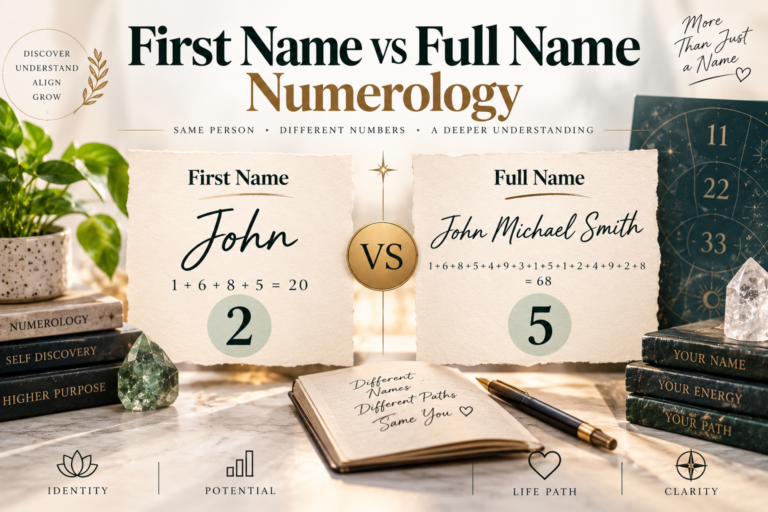
Should I use the full legal name or a common nickname when calculating?
Most traditional resources recommend calculating the full name exactly as it will appear on official documents, since that’s considered the more complete and permanent version. Some families also separately check a common nickname if that’s what the child will primarily go by.
Which numerology system is better for baby naming — Pythagorean or Chaldean?
Neither is objectively better. Pythagorean numerology is more common in Western resources and easier to double-check by hand, while Chaldean numerology is more traditional in Vedic-influenced practice. The most important thing is picking one system and staying consistent with it throughout the process.
What if none of our favorite names produce a favorable number?
Most numerologists would suggest not forcing the decision. A name chosen purely for family, sound, or meaning reasons is still a complete and valid choice — numerology compatibility is generally treated as a bonus consideration, not a strict requirement for a name to be “correct.”
Can middle names affect the calculation too?
Yes. If a middle name is included in the full legal name, it contributes to the total expression number just like the first and last name do, so it’s worth calculating the full name as a whole rather than just the first name in isolation.
How far in advance should we start this process?
There’s no strict timeline, but most families find it easier to begin once a shortlist of two or three names has already formed naturally, rather than starting from a completely blank list. Calculating numbers for a smaller, more meaningful set of names tends to produce a clearer picture than running every name a family has ever liked through the process at once, which can make the comparison step feel overwhelming rather than helpful.
Final Thought
Baby Naming with Numerology works best as one thoughtful layer added to a decision that ultimately comes down to what feels right for your family — not as a rigid formula that overrides personal taste, family tradition, or how a name actually sounds spoken aloud every day. Used this way, it gives parents who value the tradition a structured way to double-check a name they already love, rather than a rulebook dictating what that name has to be.