Business Name Numerology: How to Pick a Lucky Brand Name
A business name carries more weight than most founders realize when they first sit down to choose one. It shows up on invoices, storefronts, websites, and every piece of paperwork the business will ever file, and for many owners, the decision to pick a lucky brand name goes beyond how the word sounds or whether the domain is available. Numerology has been applied to trade and commercial names for centuries, particularly within Chaldean tradition, where business names were historically evaluated the same way personal names were — by breaking them down letter by letter into a single guiding number.
This guide walks through the full process founders use to pick a lucky brand name, from calculating a candidate name’s number to checking it against the founder’s own numerology profile, without assuming any prior background in the subject.
Why Business Owners Turn to Numerology When Naming a Company
The idea behind using numerology to pick a lucky brand name rests on a simple premise: every name, when its letters are converted into numbers and added together, produces a single guiding value — often called the expression number — that’s believed to carry its own set of qualities. A name associated with steady growth and structure reads differently, numerologically speaking, from one associated with rapid expansion or public visibility, and founders who take this approach try to match the name’s number to the kind of business they’re building.
This isn’t treated as a substitute for sound business fundamentals — a strong product, a clear market, and solid execution still matter more than any single number. Most founders who use this method treat it as one additional filter applied to a shortlist of names they already like, similar to checking domain availability or trademark conflicts before finalizing a decision.
Decide Which Numerology System You’ll Use
Before calculating anything, choose between Chaldean numerology and Pythagorean numerology, since the two systems assign different values to several letters of the alphabet and will produce different results for the same business name.
Chaldean numerology traces back to ancient Babylon and groups letters according to their phonetic sound rather than their position in the alphabet. It has a long-standing association with trade and commercial names specifically, which is part of why many numerologists recommend it over Pythagorean numerology when the goal is to pick a lucky brand name rather than a personal one. Pythagorean numerology, by contrast, assigns numbers to letters in a simple repeating sequence based on alphabetical order, and tends to be the default system used across Western numerology apps and calculators.
Neither system is objectively correct. What matters is pick a lucky brand name one and staying consistent with it through every name you test, since mixing values from both systems partway through a calculation produces a result that doesn’t belong to either tradition.
Step 2: Build a List of Name Candidates
This step has nothing to do with numbers yet. Before layering numerology onto the process, put together a list of five to ten name candidates based on how well each one reflects the business, how easy it is to say and spell, and how it fits the industry. A name that’s forced purely to hit a specific number tends to sound awkward and can work against brand identity rather than support it, so most founders trying to pick a lucky brand name start with names they’d be happy with regardless of what the numbers eventually show.
Step 3: Calculate the Expression Number for Each Candidate Name
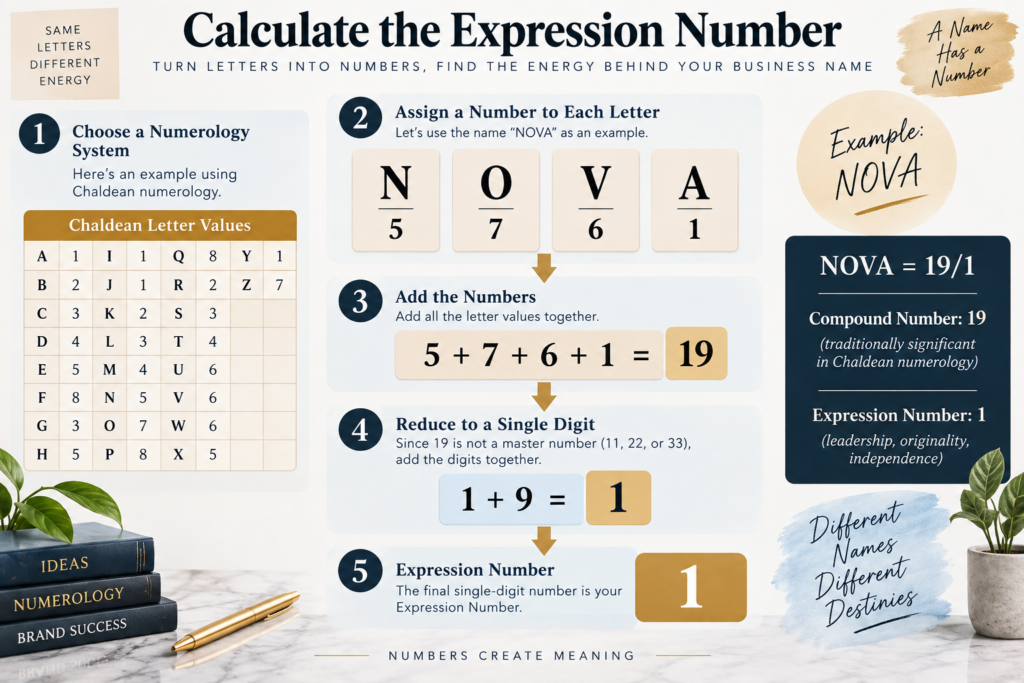
With a letter system chosen, work through each candidate the same way: assign every letter its numeric value using the relevant letter-to-number chart, add the values together, and reduce the total to a single digit unless it lands on a master number such as 11, 22, or 33, which is typically left unreduced.
For example, using Chaldean values, the name “NOVA” breaks down as N=5, O=7, V=6, A=1, adding up to 19. That two-digit total, 19, is the compound number — a figure some traditional Chaldean readings treat as meaningful on its own, not just as a step toward the final result. Reducing it further (1 + 9) brings the final single-digit value down to 1, a number traditionally linked to leadership and originality.
Work through this same process for every candidate on your list before moving forward, so each name is paired with a clear final number and its underlying compound number.
Step 4: Understand What Each Number Traditionally Represents
Once you have a number attached to each candidate name, it helps to know what that number is traditionally associated with, so you can judge whether it fits your business rather than just picking whichever number “feels” luckiest.
| Number | Traditional Association | Business Fit |
|---|---|---|
| 1 | Leadership, originality, independence | Startups, personal brands, solo founders |
| 2 | Partnership, diplomacy, cooperation | Agencies, consultancies, joint ventures |
| 3 | Communication, creativity, visibility | Media, marketing, creative studios |
| 4 | Structure, discipline, reliability | Construction, logistics, financial services |
| 5 | Change, adaptability, movement | Travel, tech startups, retail |
| 6 | Harmony, service, responsibility | Hospitality, healthcare, family businesses |
| 7 | Analysis, expertise, specialization | Consulting, research, education |
| 8 | Ambition, authority, material success | Finance, real estate, large-scale enterprise |
| 9 | Completion, humanitarian focus, broad reach | Nonprofits, global brands, wellness |
This table is a useful reference the first time you try to pick a lucky brand name, since it turns an abstract number into something you can actually weigh against your business plan.
Step 5: Check the Name Against the Founder’s Life Path Number

Many numerologists recommend comparing a candidate business name’s expression number against the founder’s own life path number, which is calculated from the founder’s date of birth rather than the business name itself. The reasoning is that a business often carries the imprint of the person building it, so a name whose number complements the founder’s life path number is thought to create a stronger overall alignment than a name chosen in isolation.
There’s no single universal rule for what counts as a strong match. A matching number is often viewed as reinforcing, while certain combinations are traditionally considered complementary depending on which numerology resource you’re following. If this comparison matters to you, it’s worth sticking to one consistent compatibility chart rather than mixing rules from different sources partway through the process — a habit that tends to produce confusing, contradictory results.
Step 6: Weigh Sound, Memorability, and Practical Branding Alongside the Number
A name’s numerological value is only one input, and treating it as the only one tends to produce a shortlist that scores well numerically but doesn’t work as an actual brand identity. At this stage, say each remaining candidate out loud, check how it looks written down, and consider how it would appear on a sign, a website header, or a business card. A name still needs to function in the real world — easy to spell, easy to remember, and free of unintended meanings in other languages if the business plans to operate internationally.
Founders who successfully pick a lucky brand name usually treat the numerology step as a filter applied after the practical branding checks, not before them — narrowing an already-solid shortlist rather than starting from numbers alone.
Step 7: Consider Legal and Domain Availability Before Finalizing
Before locking in a final choice, confirm the name isn’t already trademarked in your industry, check that a reasonable domain variation is available, and make sure the name can be registered as a business entity in your jurisdiction. A name can score perfectly on paper numerologically and still be unusable if it’s already claimed elsewhere this step has nothing to do with numerology, but skipping it after investing time in the numbers is one of the most common regrets founders report after the fact.
If you want to quickly compare compound numbers and expression numbers across your shortlist without recalculating everything by hand, a Name Numerology Calculator can run through Step 3 for each candidate in seconds, leaving more time for the comparison work in Steps 4 through 7.
Step 8: Test the Shortlist With People Outside the Process
Before finalizing a decision, it helps to show the top two or three candidates to people who haven’t been involved in the numerology calculations at all — employees, potential customers, or people in the target industry. Ask how each name reads on a business card, how it sounds said out loud in a sentence like “I bought this from [name],” and whether it’s easy to spell after hearing it once. A founder trying to pick a lucky brand name can get so focused on the numbers that a genuinely awkward or hard-to-remember name slips through simply because it produced the “right” total.
This step also surfaces unintended associations a numerology calculation can’t catch — slang meanings, unfortunate abbreviations, or names that sound too close to an existing competitor. None of that shows up in a letter-to-number chart, but all of it affects whether a name actually works once the business is live.
How Different Industries Tend to Approach This Process
Founders across different industries often weigh numerology differently depending on how visible the brand name is to customers versus how much it functions purely as a legal or operational label.
A consumer-facing brand a café, a boutique, a creative agency tends to put more weight on the numerology step precisely because the name is said aloud constantly, printed on packaging, and central to how customers experience the business day to day. In these cases, founders trying to pick a lucky brand name often spend more time on Steps 4 through 6, since the number’s traditional associations feel more directly tied to the customer-facing identity of the business.
A business-to-business company, a holding company, or a name that exists mainly for legal registration purposes tends to receive lighter numerology treatment. The founder might still run the calculation out of personal interest or family tradition, but practical factors like domain availability, ease of registration, and how the name reads on formal documents usually carry more weight than the numerological reading itself in these cases.
Common Mistakes Founders Make When Naming a Business This Way
A handful of mistakes come up repeatedly among founders trying to pick a lucky brand name:
- Mixing Chaldean and Pythagorean letter values in the same calculation, producing a number that doesn’t belong to either system.
- Choosing a name purely to hit the number 8, assuming it automatically guarantees financial success, when the number is only one traditional association among several relevant factors.
- Skipping the founder’s life path comparison entirely, missing a step many numerologists consider central to the process.
- Ignoring practical branding factors, ending up with a name that scores well numerically but is hard to pronounce, spell, or remember.
- Finalizing a name before checking trademark and domain availability, which can force a costly rename after the business has already launched.
Frequently Asked Questions
Is there one universally lucky number for business names?
Not really. The number 8 is frequently cited for its association with material success and authority, but different businesses in different industries are often better matched to other numbers — a creative studio, for instance, may benefit more from a number linked to communication and visibility than one linked purely to financial ambition.
Should I rename an existing business if the current name doesn’t have a favorable number?
Most numerologists don’t recommend renaming an established, successful business purely over a numerology mismatch, since a strong existing reputation and customer recognition generally carry far more weight than a name’s number. This process is usually most useful before a name is finalized, not after a business is already running.
Does the business name need to match the founder’s life path number exactly?
No. An exact match is one favorable outcome among several. Numbers considered traditionally complementary to the founder’s life path number are often viewed as equally strong, sometimes stronger, since they add balance rather than pure repetition.
Can a business have more than one name checked — like a legal name and a trading name?
Yes. Some founders calculate both the full legal registered name and a shorter trading or brand name separately, since customers may primarily interact with one version while the other exists mainly for legal and tax purposes.
How important is this compared to trademark and market research?
Numerology is generally treated as a supporting consideration, not a primary one. Trademark conflicts, domain availability, and how a name resonates with a target market are practical business concerns that should take priority over a numerological reading when the two are in tension.
Does the numerology of a business name matter more for a physical store than an online business?
Not particularly. The traditional principles apply the same way regardless of whether customers encounter the name on a storefront sign or a website header. What tends to differ is how often the name is spoken aloud versus simply read — a name that’s said constantly in person, like a restaurant or salon, may get more weight placed on how it sounds, while a purely online brand might weigh spelling and searchability more heavily alongside the numerology reading.
Can a partnership or co-founded business use both founders’ life path numbers?
Yes. Some numerologists recommend checking a candidate business name against both founders’ life path numbers rather than just one, looking for a name whose expression number reasonably complements each individually. There’s no strict rule requiring a single “correct” method here — some practitioners average the two life path numbers together first, while others compare the business name against each one separately and look for a name that reads well against both.
Final Thought
Choosing to pick a lucky brand name through numerology gives founders a structured way to add one more layer of consideration to a decision that already involves branding, market fit, and legal availability. Used alongside those practical checks — not instead of them — it can help narrow a shortlist down to a name that feels aligned on more than just instinct, while the actual success of the business still comes down to the product, the market, and the work behind it.