
The Science Behind Numerology: Myth or Tradition Explained
Ask ten people what they think of numerology and you’ll get three camps. One group treats it as a genuine predictive tool. Another dismisses it entirely as superstition dressed up in arithmetic. The third — probably the largest — has never thought about it hard enough to land anywhere.
This article sits with the uncomfortable middle. The Science Behind Numerology: Myth or Tradition is a question worth asking honestly, not to declare a winner, but because the answer turns out to be more interesting than any single label allows.
Quick Answer Up Front
Before the long version, here’s the short one:
| Question | Short Answer |
|---|---|
| Is numerology a science? | No. It fails the basic tests of falsifiability and reproducible prediction. |
| Is numerology a myth? | Partly. Some claims made about it are demonstrably untrue. |
| Is numerology a tradition? | Yes. It’s a documented cultural practice stretching back thousands of years. |
| Does it have any real effect on people? | Sometimes — though the mechanism is psychological, not numerical. |
The rest of this article explains how each of those answers was reached, and why the three categories aren’t mutually exclusive.
Part One: What “Science” Actually Requires
You can’t evaluate the science behind numerology without first being clear about what the word “science” demands. It isn’t a vague synonym for “serious” or “well-researched.” It’s a specific method with specific requirements.
A claim qualifies as scientific when it meets roughly these conditions:
- It makes predictions that could turn out to be wrong (falsifiability)
- Those predictions are specific enough to test — not vague enough to fit any outcome
- Independent researchers can reproduce the results under the same conditions
- The mechanism proposed is consistent with what’s already established about how the world works, or comes with evidence strong enough to overturn it
Numerology struggles at the first hurdle and never really recovers.
Where Numerology Fails the Falsifiability Test
Consider a typical numerology statement: “A Life Path Number 7 is introspective and drawn to deeper questions.”
Now ask yourself — what outcome would prove that wrong? If a 7 is quiet and thoughtful, the reading holds. If a 7 is loud and social, a practitioner can say they’re “compensating for an inner introspective nature.” If they’re somewhere in between, that fits too.
A statement that survives every possible outcome isn’t making a prediction. It’s making a description flexible enough to never be tested. This is the core reason the science behind numerology doesn’t hold up under formal scrutiny — not because numerologists are dishonest, but because the claims aren’t built in a testable shape to begin with.
The Mechanism Problem
Even setting aside testability, there’s a second issue. Numerology proposes that letters carry numeric values that reflect something real about a person’s character or destiny. For this to work mechanically, you’d need:
- A reason why these specific letter-to-number assignments are correct and others aren’t
- An explanation for why the assignments differ between Pythagorean numerology and Chaldean numerology, yet both are treated as valid
- A mechanism connecting the resulting number to the person
That second point is worth sitting with. Two established numerology systems give different numbers for the same name. If both are “correct,” then the numbers can’t be describing an objective property of the person — because the same person has two different values depending on which chart you consult. Discussion of the science behind numerology frequently runs aground exactly here.
Part Two: The Tradition Side of the Ledger

Here’s where the picture gets more interesting. Failing as a science doesn’t mean a practice is worthless or fabricated. Numerology’s claim to being a genuine tradition is far stronger than its claim to being a science, and that distinction matters.
A Documented Historical Lineage
| Era | Tradition | What It Contributed |
|---|---|---|
| Ancient Babylon | Chaldean numerology | Letter values grouped by sound vibration; number 9 treated as sacred and excluded |
| Ancient Greece | Pythagorean numerology | Numbers as the structure of reality; sequential letter assignment (A=1, B=2…) |
| Hebrew tradition | Gematria | Letters doubling as numbers in scripture; linked to Kabbalah |
| Ancient India | Vedic numerology | Name analysis tied to birth data and planetary rulership |
| Early 1900s | Modern numerology | Standardized charts, the Life Path Number, master numbers 11/22/33 |
These aren’t invented lineages. Each one is documented, studied by historians, and traceable through surviving texts. Anyone examining the science behind numerology honestly has to concede that the historical claim is on much firmer ground than the predictive claim.
Why Tradition Is Its Own Category
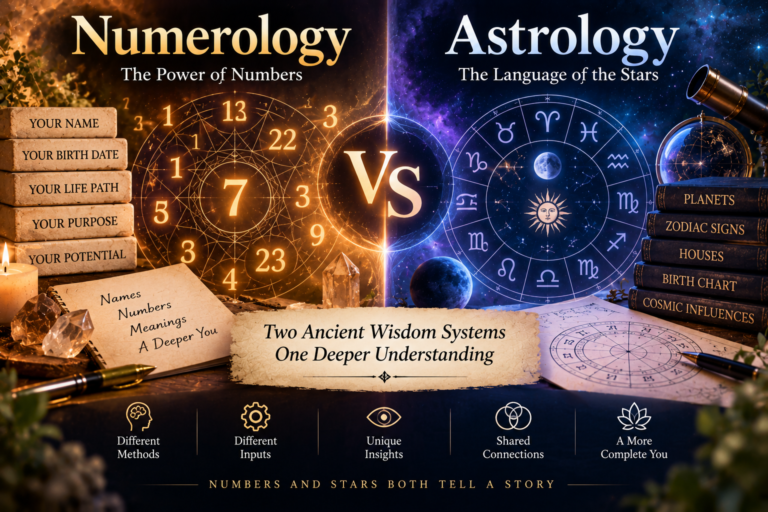
Consider a comparison. Astrology, Tarot, feng shui, and numerology all fail as sciences. All four remain culturally significant practices with structured internal logic, professional practitioners, and millions of participants.
Calling something a tradition isn’t a consolation prize. It’s a different kind of claim entirely:
- A scientific claim says: this is objectively true and testable
- A traditional claim says: this is a practice a culture has carried forward and found meaningful
Numerology makes a strong case for the second and a weak one for the first. The confusion usually starts when practitioners present traditional claims in scientific language — words like “vibration,” “frequency,” and “energy” borrowed from physics but used in ways physics wouldn’t recognize.
Part Three: The Psychology Nobody Disputes
Here’s the part that surprises skeptics: the effects people report from numerology readings are real. What’s disputed is the cause.
Several well-documented psychological mechanisms explain why a numerology reading can feel accurate without the numbers doing any of the work.
The Barnum Effect
Named after showman P.T. Barnum, this is the tendency to accept vague, broadly applicable personality descriptions as uniquely accurate about oneself.
Classic Barnum statement: “You have a great deal of unused capacity which you haven’t turned to your advantage.”
Nearly everyone agrees with this. It describes almost no one specifically. A significant share of numerology number descriptions follow this exact pattern — broad enough to resonate, vague enough to never be wrong.
Confirmation Bias
Once someone learns they’re a Life Path Number 3, described as creative and expressive, a filter switches on:
- Creative moments → “That’s my 3 showing” ✅ remembered
- Uncreative moments → “I was just tired” ❌ discounted
The number didn’t shape the person. It shaped which memories got filed as evidence.
Subjective Validation
This one is stronger than most people expect. Studies on personality-profile acceptance show that when people are told a description was generated specifically for them, acceptance rates climb sharply — even when everyone in the room received the identical description.
Personalization changes perceived accuracy, regardless of actual accuracy. Any honest look at the science behind numerology has to account for this, because it explains the sensation of a reading “hitting” without requiring the numbers to mean anything.
The Self-Fulfilling Loop
The most consequential mechanism of the four. If someone reads that their Expression Number marks them as a natural leader, and they subsequently volunteer for a leadership role they’d otherwise have skipped — the reading became true through behavior, not prediction.
This is a genuine effect with a fully mundane explanation. The number worked as a nudge, not a forecast.
Part Four: What Research Has Actually Found
Direct formal testing of numerology is thin, largely because the claims resist testable framing. But adjacent research on similar systems is substantial and consistent.
What the broader body of research shows:
- Personality descriptions from numerology, astrology, and similar systems are accepted at similar rates regardless of whether they were correctly or randomly assigned
- Practitioners of these systems do not outperform chance when matching charts to actual individuals under blinded conditions
- Acceptance rates rise when a description is framed as personalized, independent of content
- No physical mechanism linking letter-derived numbers to personality traits has been identified or proposed in testable form
One honest caveat deserves stating: absence of supporting evidence is not identical to proof of impossibility. It does, however, mean that anyone claiming numerology is scientifically validated is making a claim the evidence doesn’t currently support. The science behind numerology, as a body of verified findings, is essentially empty — not because researchers refused to look, but because there’s nothing testable to examine.
Part Five: The Internal Inconsistency Problem
This deserves its own section, because it’s the argument most likely to give even sympathetic readers pause.
Different Systems, Different Answers

Run the same name through two calculators and you can easily get two different results. Not because of a bug — because of a design difference.
| Factor | Pythagorean | Chaldean |
|---|---|---|
| Origin | Ancient Greece | Ancient Babylon |
| Letter logic | Sequential (A=1, B=2, …) | Grouped by sound vibration |
| Number 9 | Included normally | Excluded from the chart |
| Typical use | Personal names | Business names, traditional readings |
Same person. Same letters. Two different numbers. Both traditions considered legitimate.
The Y Problem
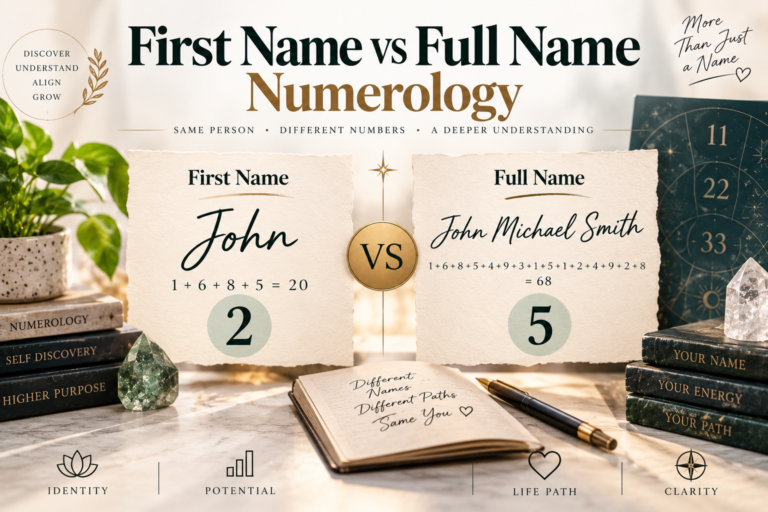
Then there’s the letter Y, which some systems count as a vowel, others as a consonant, and others as conditionally either depending on surrounding letters. This single ambiguity changes the Soul Urge Number and Personality Number for a large share of names.
The Name Version Problem
And which name do you even use?
- Birth certificate name — traditional recommendation
- Nickname — how you’re actually known
- Married name — legally current, but not original
- Professional name — public-facing identity
Each produces a different result. Numerologists disagree about which takes priority.
Stacked together, these three ambiguities mean a single person can legitimately produce a dozen different “correct” numbers. For a tradition, that flexibility is workable — different lenses, different insights. For a science, it’s disqualifying. This is perhaps the sharpest illustration of why the science behind numerology can’t be salvaged by better methodology. The inconsistency is structural, not procedural.
Part Six: The Vocabulary Problem
There’s a specific habit in modern numerology writing that deserves its own examination, because it’s the main reason the myth-versus-tradition question gets muddied so often. Traditional practices increasingly borrow scientific vocabulary they haven’t earned.
Words Borrowed From Physics
| Term Used | What It Means in Physics | How Numerology Uses It |
|---|---|---|
| Vibration | Oscillation of a physical system at a measurable frequency | An undefined quality attributed to letters and numbers |
| Frequency | Cycles per second, measured in hertz | A metaphor for “character” or “energy type” |
| Energy | A measurable quantity with defined units (joules) | A loose stand-in for mood, personality, or influence |
| Resonance | Amplification when a driving frequency matches a natural one | A metaphor for compatibility between numbers |
Each of these words has a precise technical meaning. None of those meanings apply in the numerological sense. A letter doesn’t oscillate. A name doesn’t have a measurable frequency in hertz. There’s nothing being amplified when two numbers are called “resonant.”
This matters because borrowed terminology creates an impression of scientific grounding that the underlying claims don’t have. A reader encountering the phrase “the vibrational frequency of your name” might reasonably assume something measurable is being described. Nothing is.
Why This Habit Developed
The borrowing isn’t usually deliberate deception. It tracks a broader cultural shift: as science became the dominant authority on what counts as real, older traditions adapted their language to sound compatible with it rather than opposed to it. Numerology was called the Science of Numbers or Arithmancy long before the modern term existed, and the 20th-century rebranding to “numerology” carried the same instinct — package an old practice in a name that sounds systematic and current.
The irony: the tradition’s strongest claim is its history, and dressing that history in borrowed lab coats weakens it rather than helping. A practice with five thousand years of documented cultural presence doesn’t need to pretend to be physics.
Part Seven: How Numerology Compares to Neighboring Practices
Placing numerology alongside similar systems clarifies what’s distinctive about it and what isn’t.
| Practice | Input Used | Scientific Status | Cultural Depth |
|---|---|---|---|
| Numerology | Name letters, birth date | Unsupported | Very deep — Babylon, Greece, India, Hebrew tradition |
| Astrology | Birth time and location | Repeatedly tested, no support found | Very deep, extensively documented |
| Tarot | Card draw | Not framed as predictive by most modern readers | Deep, primarily European |
| Personality typing (MBTI) | Self-report questionnaire | Weak — poor test-retest reliability | Shallow, 20th century |
| Big Five personality | Validated questionnaire | Supported — reproducible, predictive | Academic, not cultural |
Two things stand out from this comparison.
First: numerology’s historical depth is genuinely impressive relative to modern alternatives. The Big Five model has far better scientific standing, but it has no cultural lineage at all — it’s a research instrument, not a tradition.
Second: MBTI is a useful mirror. It’s widely used in corporate settings, presented in scientific-sounding language, and performs poorly on reliability testing. Numerology gets dismissed as mysticism while MBTI gets boardroom meetings — yet the scientific gap between them is narrower than the reputational gap suggests. Examining the science behind numerology alongside its more “respectable” neighbors is a useful check against dismissing one system while uncritically accepting another.
Part Eight: Why Intelligent People Still Find It Useful
A common mistake among skeptics is assuming that people who engage with numerology must believe it works mechanically. Many don’t. They use it differently.
Reasons people report finding value, none of which require the numbers to be literally predictive:
- As a reflection prompt. Reading that a number is associated with independence or sensitivity gives a starting point for thinking about oneself — the way a journaling prompt does.
- As a shared vocabulary. Saying “I’m a Life Path 7” compresses a cluster of traits into something quickly communicable.
- As cultural participation. In parts of South Asia especially, numerology is woven into naming customs and family tradition. Participating is a cultural act, not a scientific claim.
- As a decision-making tiebreaker. When two options seem equal, an external framework can break the deadlock — the value is in ending deliberation, not in being right.
- As structured curiosity. Some people simply enjoy the system, the same way others enjoy learning Tarot symbolism or historical mythology.
None of these uses are irrational — provided the user understands which claim they’re making. Trouble arises only when a reflection tool gets treated as a diagnostic instrument.
Part Nine: Where the Line Should Be Drawn
Examining the science behind numerology honestly means being clear about where the practice becomes genuinely problematic rather than merely unproven.
Low-Risk Uses ✅
- Personal reflection and journaling prompts
- Cultural or family naming traditions
- Curiosity and entertainment
- Creative naming inspiration for projects or businesses
High-Risk Uses ⚠️
- Medical decisions — choosing or avoiding treatment based on a reading
- Major financial commitments made primarily on numerological grounds
- Relationship decisions — ending or avoiding a relationship over number incompatibility
- Hiring or exclusion — screening people by their numbers
- Expensive “corrective” services — paid name changes or rituals promising specific life outcomes
The distinction is straightforward: using numerology to think is low-risk. Using it instead of thinking, in situations with real consequences, is where harm becomes possible.
Part Ten: The Verdict, Laid Out Plainly
So — myth or tradition?
The honest answer refuses the binary. Here’s the full accounting:
| Claim | Verdict | Reasoning |
|---|---|---|
| Numerology is a science | ❌ False | Unfalsifiable, unreproducible, no proposed mechanism |
| Numerology is ancient tradition | ✅ True | Documented across Babylon, Greece, India, Hebrew scholarship |
| Numerology predicts the future | ❌ Unsupported | No evidence of above-chance predictive accuracy |
| Numerology readings feel accurate | ✅ True | Barnum effect, confirmation bias, subjective validation |
| Numerology can influence behavior | ✅ True | Via self-fulfilling prophecy — a real but mundane mechanism |
| Numerology is entirely made up | ❌ Misleading | The tradition is genuine; the predictive claims are what fail |
The word “myth” is doing too much work in the original question. In casual use, myth means “false belief.” In its older sense, a myth is a story a culture tells to organize meaning. Numerology is a myth in the second sense and a failure in the first — and the science behind numerology is best understood as a question about which sense someone means.
Part Eleven: A Practical Framework for Readers
If you’re trying to decide how much weight to give your own numerology reading, three questions settle it quickly:
1. What am I asking this for? Reflection and curiosity → go ahead. Prediction or major decisions → look elsewhere.
2. Would I accept this description if it had been assigned to me at random? If yes, the description is too vague to be telling you anything specific about you.
3. Am I treating this as information or as permission? Using a reading as permission to do something you already wanted — that’s the reading working as a nudge. Perfectly reasonable, as long as you know that’s what’s happening.
Common Questions, Answered Directly
Has numerology ever been formally tested?
Rarely in isolation, and the reason matters. Formal testing requires falsifiable claims, and numerology’s descriptions are typically framed broadly enough that no result could contradict them. Adjacent research on astrology and personality profiling — which face the same structural issue — has been conducted extensively and consistently finds no above-chance accuracy.
If there’s no evidence, why do so many people say it works?
Because something real is happening, just not what people assume. The Barnum effect makes vague descriptions feel personal. Confirmation bias filters memory toward supporting examples. Subjective validation raises perceived accuracy whenever a reading is framed as personalized. The experience is genuine; the explanation is psychological rather than numerical.
Does the ancient origin count as evidence?
No, and this is where arguments about the science behind numerology often go sideways. Age establishes cultural significance, not accuracy. Plenty of practices survived millennia without being correct, and plenty of correct ideas are only decades old. Longevity is evidence of usefulness to communities, not of predictive validity.
Is there any harm in using it?
Depends entirely on the use. As a reflection tool or cultural practice, the risk is close to zero. As a substitute for medical, financial, or relationship judgment, the risk is real — not because the numbers do damage, but because they can displace reasoning that the situation actually required.
Could future research validate it?
Only if the claims were reframed into a testable shape first, which would mean giving up much of the flexibility that makes readings feel accurate. That trade-off is why validation is unlikely — the qualities that make numerology satisfying as a tradition are the same ones that make it untestable as a science.
Final Thoughts
The science behind numerology, examined directly, comes up empty. There’s no verified mechanism, no reproducible predictive power, and structural inconsistencies that no amount of refinement could resolve. On the scientific question, the answer is settled.
But “not a science” and “worthless” are different claims, and collapsing them together loses something. Numerology is a genuine tradition with a documented five-thousand-year lineage, an internally coherent structure, and real cultural weight across multiple civilizations. It survives because it offers a framework for reflection, not because it passes a laboratory test — and it was never really built to pass one.