Understanding Pythagorean Numerology: The Complete Beginner’s Guide
That belief is the seed every modern numerology calculator eventually grew from. Understanding Pythagorean numerology means starting there — not with a chart or a formula, but with a very old idea that numbers describe reality itself, and that a name, being made of letters, must therefore carry numeric meaning too.
This guide breaks that idea down into something usable: where it came from, how the letter chart actually works, how to calculate a name by hand, and how it compares to the older Chaldean system it so often gets confused with.
Lesson One: The Man Behind the Method
Understanding Pythagorean numerology starts with a name most people already half-recognize from a geometry classroom: Pythagoras, the Greek mathematician and philosopher who lived roughly 2,500 years ago. He’s remembered today mostly for a theorem about right triangles, but his actual philosophical project was much bigger than a single equation.
Pythagoras led a school of thought that treated numbers as the fundamental building blocks of the universe — not metaphorically, but literally. Music, geometry, planetary motion, and human character were all believed to reduce to numerical relationships underneath the surface. If that’s true of everything, the reasoning went, it should be true of names too.
A quick historical note worth knowing: the specific letter-to-number system now called “Pythagorean numerology” wasn’t necessarily written down by Pythagoras himself in the form used today. Some historians trace parts of the “numbers as universal structure” framework to Philolaus, a student working within the Pythagorean school after its founder’s death. The name stuck to the system regardless, and it remains the most widely recognized label in Western numerology.
Lesson Two: The Chart Itself
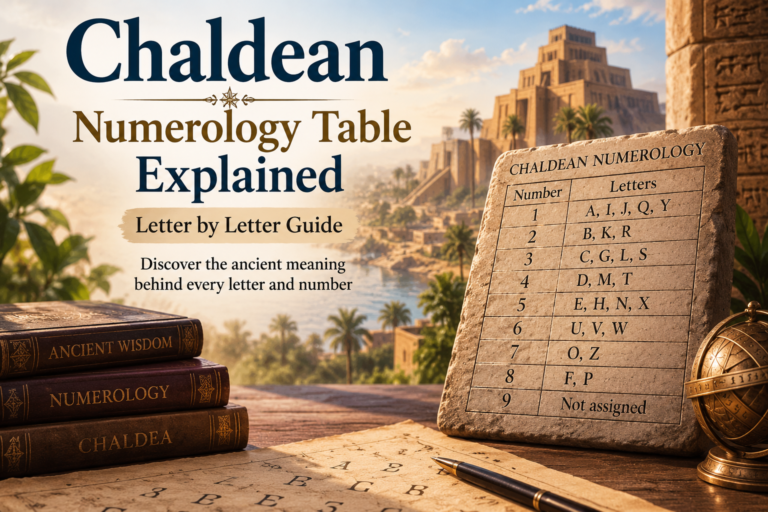
Here’s where understanding Pythagorean numerology gets genuinely simple compared to its older cousin. Instead of grouping letters by sound the way Chaldean numerology does, the Pythagorean system runs straight through the alphabet in a clean, repeating sequence.
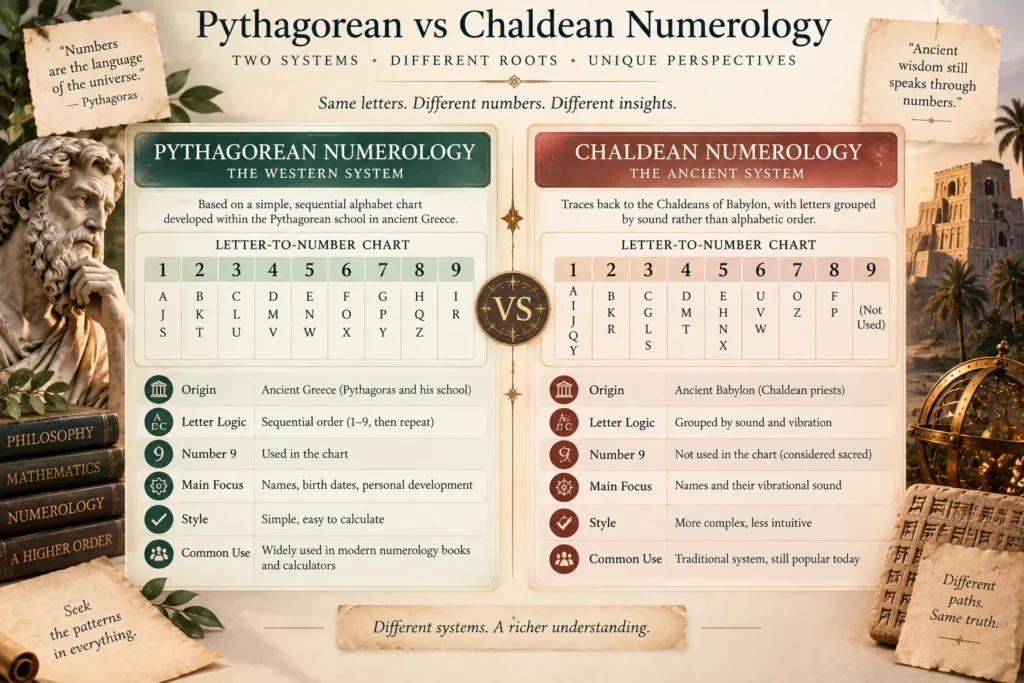
The Pythagorean letter-to-number chart:
| Number | Letters |
|---|---|
| 1 | A, J, S |
| 2 | B, K, T |
| 3 | C, L, U |
| 4 | D, M, V |
| 5 | E, N, W |
| 6 | F, O, X |
| 7 | G, P, Y |
| 8 | H, Q, Z |
| 9 | I, R |
Notice the pattern: A is 1, B is 2, and the sequence keeps climbing until it hits 9, then loops back to 1 and starts again with J. This is the entire logic of the chart. No sound-grouping, no missing numbers, nothing to memorize beyond “count to 9, then repeat.”
This simplicity is a large part of why Pythagorean numerology became the default system behind most Western numerology apps and books. Anyone can reconstruct the chart from scratch in under a minute, which makes a calculator’s output feel verifiable rather than mysterious.
Lesson Three: Running the Numbers
Theory only goes so far. Understanding Pythagorean numerology properly means working through an actual calculation, step by step.
The process:
- Write out the name being calculated
- Convert every letter into its number using the chart above
- Add every value together into one raw total
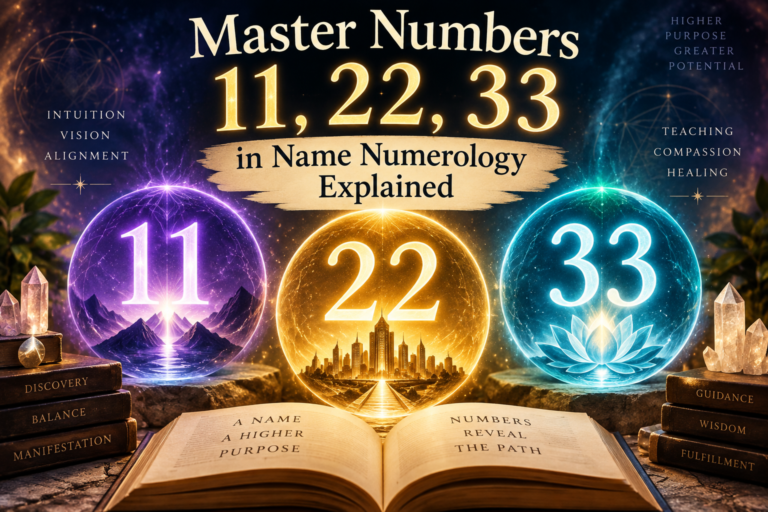
- Reduce that total by adding its digits together, repeating until one digit remains — unless the total lands on a master number (11, 22, or 33), which is typically left unreduced
Worked Example: “Anna”
| Letter | A | N | N | A |
|---|---|---|---|---|
| Value | 1 | 5 | 5 | 1 |
Add the values: 1 + 5 + 5 + 1 = 12. Reduce further: 1 + 2 = 3. Under Pythagorean numerology, “Anna” produces a core number of 3.
Worked Example: “Robert”
| Letter | R | O | B | E | R | T |
|---|---|---|---|---|---|---|
| Value | 9 | 6 | 2 | 5 | 9 | 2 |
Add the values: 9+6+2+5+9+2 = 33. Since 33 is a recognized master number, most readings would preserve it rather than reducing it further to 6 (3+3).
Lesson Four: Three Numbers From One Name
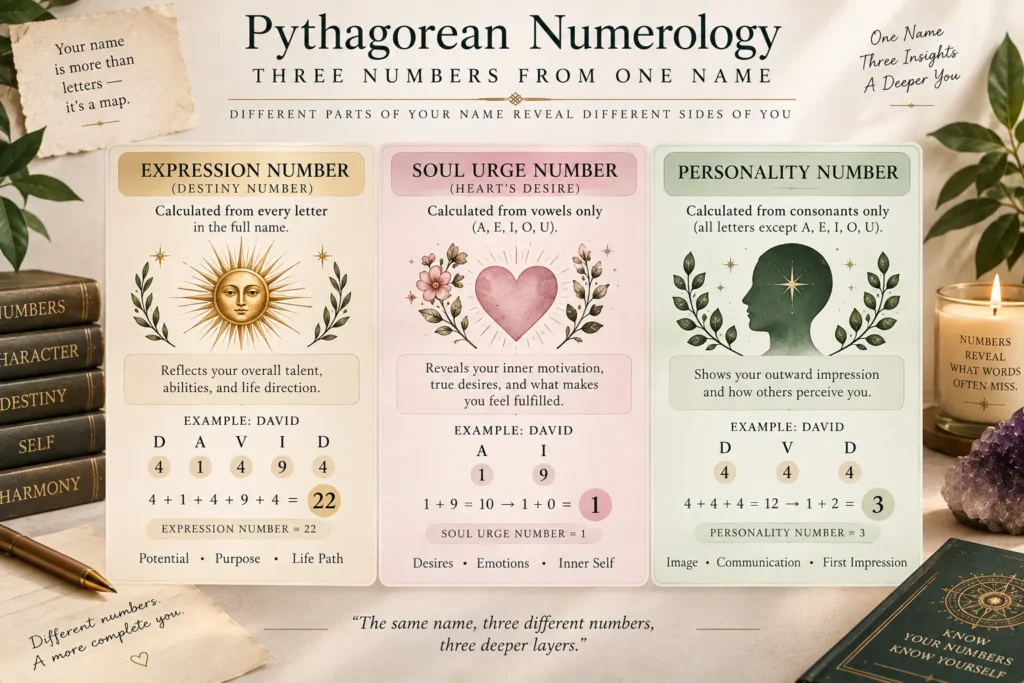
A full Pythagorean reading rarely stops at a single figure. Once someone understands the letter chart, three related numbers tend to follow:
| Number | Calculated From | What It’s Said to Reflect |
|---|---|---|
| Expression Number (Destiny Number) | Every letter in the full name | Overall talent and general life direction |
| Soul Urge Number (Heart’s Desire) | Vowels only | Inner motivation and private desire |
| Personality Number | Consonants only | Outward impression, how others perceive the person |
Understanding Pythagorean numerology at this level means recognizing that these three numbers are all built from the same source chart, just applied to different slices of the same name. Add the Soul Urge total and the Personality total together, and it should match the Expression Number’s total before final reduction — a useful way to double-check a manual calculation for errors.
Lesson Four and a Half: A Full Worked Breakdown
It helps to see all three numbers calculated from a single name rather than reading about them separately. Take the name “David.”
The letters are D, A, V, I, D. Splitting into vowels and consonants: the vowels are A, I; the consonants are D, V, D.
Soul Urge (vowels only): A is 1, I is 9. Total: 1 + 9 = 10, which reduces to 1 (1+0).
Personality (consonants only): D is 4, V is 4, D is 4. Total: 4 + 4 + 4 = 12, which reduces to 3 (1+2).
Expression Number (full name): Add every letter — D(4) + A(1) + V(4) + I(9) + D(4) = 22. Since 22 is a recognized master number, most readings preserve it rather than reducing further to 4.
Notice something useful here: the Soul Urge total (10) plus the Personality total (12) equals 22 — exactly matching the Expression Number’s total before any reduction. This consistency check works for any name and is a fast way to confirm a manual calculation didn’t go wrong somewhere along the way.
Lesson Five: Pythagorean vs Chaldean — A Direct Comparison
No honest account of understanding Pythagorean numerology is complete without placing it next to the system it constantly gets confused with. Laid out side by side:
| Factor | Pythagorean | Chaldean |
|---|---|---|
| Origin | Ancient Greece | Ancient Babylon |
| Letter logic | Sequential, repeating pattern | Grouped by sound vibration |
| Number 9 | Included normally | Excluded from the letter chart |
| Learning curve | Easy — reconstructable from memory | Harder — requires an uneven reference chart |
| Common modern use | Personal names, most Western calculators | Business names, traditional South Asian readings |
Why this matters practically: run the same name through both systems and you’ll typically get two different numbers. That’s not a bug in either calculator — the two systems were built centuries apart by different cultures with different priorities, and they were never designed to agree.
Lesson Five and a Half: Why Simplicity Became an Advantage
There’s a practical reason understanding Pythagorean numerology tends to come easier to beginners than understanding its Chaldean counterpart, and it’s worth spelling out directly. A repeating 1-through-9 sequence means anyone can sanity-check a calculator’s output by hand in a minute or two. A Chaldean chart, with its uneven groupings and excluded 9, requires an actual reference sheet every single time.
This accessibility shaped which system ended up embedded in most Western numerology software, books, and casual online calculators over the past century. It wasn’t a decision based on which system was more “correct” — neither claim can really be tested that way — but a practical one based on which chart was easier to teach, easier to memorize, and easier to verify. Understanding Pythagorean numerology as the default choice for most modern tools makes a lot more sense once that accessibility factor is taken into account rather than assuming one system simply won out on merit.
Lesson Six: What the Numbers Are Said to Mean
Once a name reduces down to a single digit, the Pythagorean tradition assigns it a specific character profile:
| Number | Pythagorean Association |
|---|---|
| 1 | Independence, leadership, a strong individual drive |
| 2 | Cooperation, diplomacy, sensitivity to others |
| 3 | Creativity, self-expression, communication |
| 4 | Discipline, structure, a practical, hands-on approach |
| 5 | Freedom, adaptability, a resistance to routine |
| 6 | Responsibility, caretaking, a pull toward home and family |
| 7 | Analysis, introspection, a tendency to seek deeper answers |
| 8 | Ambition, material achievement, authority |
| 9 | Compassion, idealism, a broader humanitarian outlook |
These meanings sit close to — but not identical with — the Chaldean interpretations of the same digits, another reminder that the two systems, while sharing a numbering range of 1 through 9, developed their symbolic layers somewhat independently.
Lesson Seven: A Myth Worth Retiring
Myth: “Pythagorean numerology is the original, authentic version, and everything else is a later imitation.”
Reality: Chaldean numerology actually predates the Pythagorean system by a considerable margin, tracing back to ancient Babylon well before Pythagoras was born in Greece. What’s true is that the Pythagorean system became the dominant framework in Western numerology books, apps, and calculators — popularity and historical priority are two separate things, and understanding Pythagorean numerology accurately means keeping those apart.
Myth: “A more complicated letter chart means a more accurate reading.”
Reality: Complexity reflects design philosophy, not accuracy. Pythagorean numerology’s simplicity was a deliberate choice — mathematical elegance over sound-based nuance — not a shortcut that sacrifices depth.
Lesson Eight: The Letter Y Problem
Even a system as clean as this one has one recurring headache: the letter Y. In the standard Pythagorean chart shown above, Y sits firmly in the 7 group. But Y sometimes functions as a vowel in actual pronunciation — think “Lynn” or “Kyle” — which affects whether it should be counted toward a Soul Urge Number (vowels) or a Personality Number (consonants).
Most Pythagorean-based calculators default to treating Y strictly as a consonant regardless of pronunciation, keeping the math simple and consistent. Some more detailed calculators apply a conditional rule, counting Y as a vowel only when no other vowel appears in the same syllable. If you’ve ever compared your Soul Urge Number across two different calculators and gotten different results, checking how each one handles Y is usually the fastest way to find the source of the mismatch.
Lesson Nine: A Short Glossary
Life Path Number — calculated from a birth date rather than a name, but frequently discussed alongside Pythagorean name calculations since both use the same 1-through-9 reduction method.
Master Number — a total of 11, 22, or 33 that gets preserved rather than reduced further, treated as carrying amplified intensity within whichever calculation produced it.
Digit Reduction — the repeated process of adding a multi-digit total’s individual digits together until a single digit (or master number) remains.
Karmic Debt Number — a separate concept from master numbers, referring to totals like 13, 14, 16, or 19 that some traditions flag as carrying an unresolved lesson rather than an amplified strength.
Lesson Nine and a Half: Mistakes People Make by Hand
A handful of errors come up repeatedly when someone tries a manual calculation instead of relying on a calculator. Knowing them in advance saves a fair amount of frustration.
Reducing letters before adding them. The correct order is: assign every letter its raw value first, add every value into one total, then reduce that total. Reducing each letter individually before adding — turning a 9 into itself but somehow reducing a 12 down to 3 mid-stream — produces a different, incorrect final sum.
Losing track of master numbers. It’s easy to reduce an 11 or 22 straight through to a single digit out of habit, especially when working quickly by hand. Slowing down at each reduction step to check for 11, 22, or 33 before continuing avoids this.
Mixing letter charts mid-calculation. Remembering a Chaldean value for one letter and a Pythagorean value for another, simply because both were encountered at different times from different sources, is one of the most common ways a manual calculation goes wrong without the person realizing why.
Forgetting to settle the Y question first. Deciding upfront whether Y counts as a vowel or consonant for a given name, and sticking with that decision through the Soul Urge and Personality calculations, prevents an inconsistent result.
None of these mistakes are complicated once flagged, but they’re common enough that cross-checking a hand calculation against a reliable online calculator is generally worth the extra minute, particularly for a name with several vowels or an ambiguous Y.
Lesson Ten: Putting It All Into Practice
For anyone ready to calculate their own name, a short checklist keeps the process clean:
- Confirm you’re using the Pythagorean chart specifically, not a Chaldean one mislabeled
- Decide upfront whether you’re calculating a birth name, nickname, or professional name, since each produces a different result
- Settle on a consistent rule for the letter Y before starting, rather than switching mid-calculation
- Watch for master numbers appearing at any stage and decide whether your reading preserves or reduces them
- Cross-check your Expression Number against your combined Soul Urge and Personality totals to catch arithmetic errors
Understanding Pythagorean numerology in practice is really just this checklist applied consistently, name after name, rather than any single piece of hidden knowledge.
Lesson Eleven: Where This System Sits in the Wider World
Understanding Pythagorean numerology also benefits from knowing where it’s actually used most heavily today. While Chaldean numerology maintains a strong regional foothold across South Asia, the Pythagorean system dominates in North America, Europe, and most English-language numerology publishing. Nearly every mainstream numerology book written in English over the past century, and the overwhelming majority of free online calculators, build their letter values from this Greek-derived sequence rather than the older Babylonian one.
This doesn’t make it more legitimate — legitimacy isn’t really something either tradition can claim in a testable sense — but it does explain a pattern worth knowing: if a numerology app or website doesn’t specify which system it uses, there’s a strong statistical likelihood it’s running Pythagorean logic by default, simply because that’s the convention most Western developers inherited when building these tools.
Lesson Twelve: How This Connects to the Life Path Number
A detail that often confuses newcomers: the Life Path Number, probably the single most searched numerology term online, isn’t technically a name calculation at all. It’s built from a birth date rather than letters. Understanding Pythagorean numerology as a name-based system means recognizing that the Life Path Number sits in a slightly different category, even though it shares the same 1-through-9 reduction method and the same treatment of master numbers.
The two calculations frequently appear together in a single reading — a Life Path Number from the birth date, alongside an Expression Number, Soul Urge Number, and Personality Number from the name — but they’re answering different questions. One draws meaning from timing; the other draws meaning from identity, spelled out letter by letter. Keeping that distinction clear avoids treating the two as interchangeable when they’re calculated from entirely different sources.
Final Thoughts
Understanding Pythagorean numerology comes down to appreciating a specific design choice: a belief, inherited from ancient Greek philosophy, that numbers describe the underlying structure of reality clearly enough to be reconstructed from a simple, repeating pattern rather than a complicated reference chart. That choice is exactly why this system became the default for so many modern calculators — it’s approachable in a way its older Chaldean counterpart never tried to be. A student, a curious beginner, or a developer building a quick calculator can reconstruct the entire chart from memory, verify a result by hand, and move on, without needing a reference sheet at every step.
Knowing the history, the mechanics, and the handful of recurring confusions — the Y problem, the myth of “originality,” the difference between a Life Path Number and an Expression Number — turns a simple online calculator result into something you can actually interpret with some confidence, rather than a number that just appears on a screen with no context behind it. That’s really the whole value of learning the system properly rather than just typing a name into a box and taking whatever comes back at face value.