Is Numerology Real? A Balanced, Honest Look at the Evidence
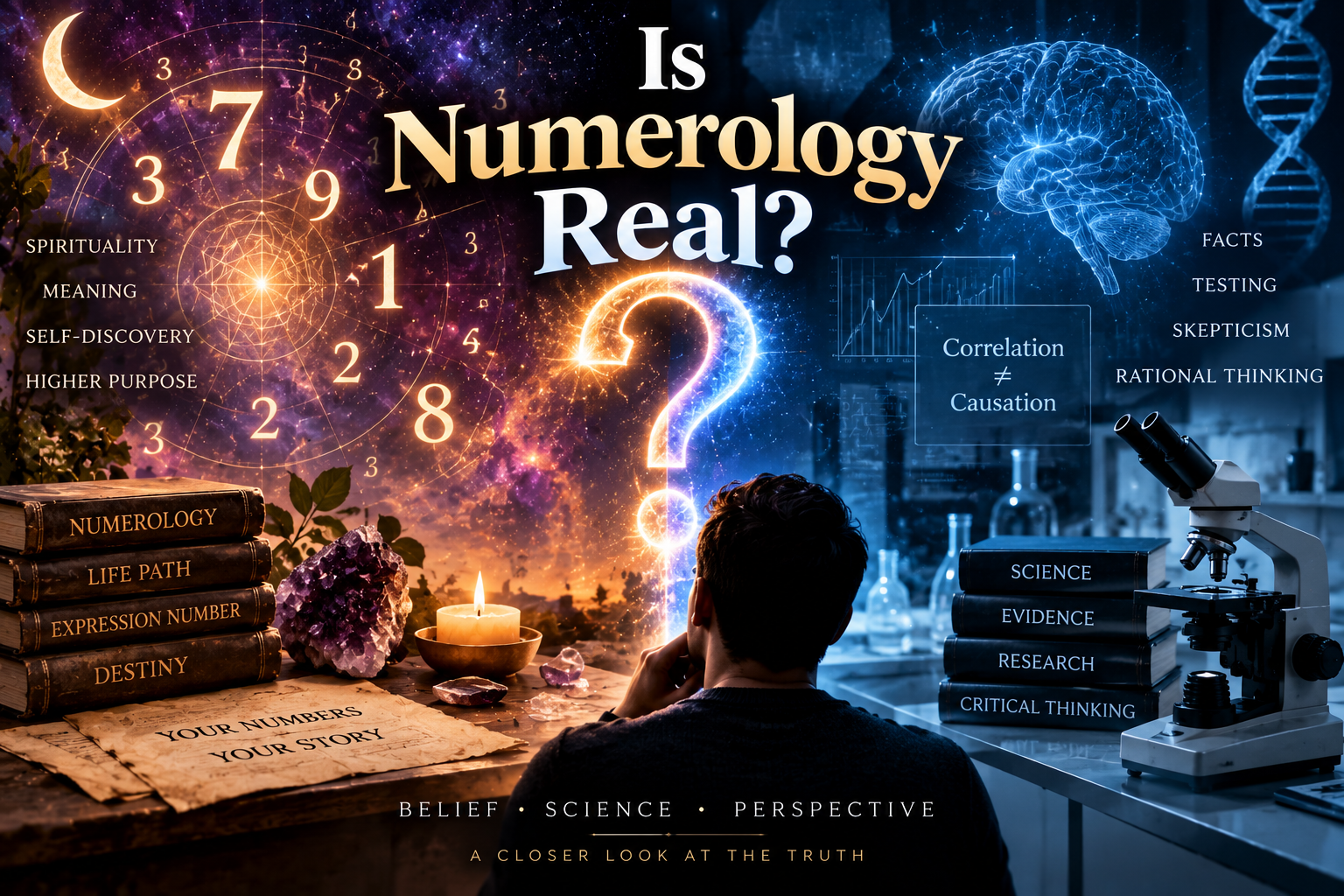
Somewhere between “it’s all nonsense” and “it explains everything about me” sits a much harder question to answer honestly: Is Numerology Real? Millions of people calculate their life path number or check their name’s expression number at some point, and a fair number of them walk away genuinely convinced the result says something true about who they are. At the same time, no controlled scientific study has ever demonstrated that a number derived from a birth date or a name predicts personality, career success, or compatibility better than chance. Both of these things can be true at once, and understanding why is more useful than picking a side before looking closely at either one.
This guide sets out to answer Is Numerology Real without dismissing the people who find genuine value in it, and without pretending the practice has scientific backing it doesn’t actually have. Both extremes miss what’s actually going on.
What Numerology Claims to Do
Before weighing whether it holds up, it helps to be precise about what numerology is actually claiming. At its core, the practice assigns numeric values to letters in a name or digits in a birth date, adds those values together, and reduces the total to a single number believed to carry specific personal meaning. A life path number, calculated from date of birth, is treated as a fixed indicator of a person’s overall direction and character. An expression number, calculated from a full name, is treated as a separate but related reading of how a person presents themselves to the world.
Two major systems dominate this practice — Pythagorean numerology, which assigns letters to numbers in a simple repeating sequence, and Chaldean numerology, which groups letters by sound and traces back to ancient Babylonian tradition. Both claim to reveal something real about a person through this letter-and-digit arithmetic, and this is the specific claim worth examining honestly.
It’s also worth distinguishing numerology from simple math trivia. Calculating a number from a name isn’t inherently mysterious — anyone can follow the same repeatable steps and arrive at the same result every time. The claim that requires scrutiny isn’t the arithmetic itself, which is entirely verifiable and consistent, but the interpretive leap that follows it: the assertion that a specific total, derived this way, corresponds to real, measurable personality traits or future outcomes. Separating the math from the interpretation makes it much easier to evaluate each part on its own terms rather than treating the whole practice as a single, indivisible claim.
The Case Against: Why Scientists Call It Pseudoscience

Mainstream science classifies numerology as a pseudoscience, a term reserved for practices that present themselves using the language and structure of science — calculations, charts, systematic rules — without meeting the actual standards science requires for a claim to be considered valid. The core issue isn’t that numerology involves numbers; it’s that the connection between a calculated number and a person’s actual traits has never been demonstrated in a way that holds up under controlled testing.
No peer-reviewed study has found that people whose names or birth dates produce a specific number reliably share the personality traits numerology assigns to that number, at a rate higher than random chance would predict. When researchers have tested astrology and numerology-adjacent claims directly, results have consistently failed to show the described numbers or signs correlating with measurable personality outcomes. This is the central reason Is Numerology Real tends to get a firm “no” from anyone evaluating the claim purely through a scientific lens — the practice makes testable claims, and those specific claims haven’t held up when actually tested.
Why It Feels So Accurate Anyway: The Psychology at Work
Here’s where the honest answer gets more interesting than a simple yes or no. Even though numerology lacks scientific support, the experience of reading a description and thinking “that’s exactly me” is genuine and well understood by psychologists — it just isn’t evidence that the number itself caused the accuracy.
The Barnum effect explains a large part of this. Named after showman P.T. Barnum, this well-documented psychological pattern describes how people rate vague, generally flattering personality descriptions as highly accurate for themselves specifically, even when the exact same description is shown to a large group of different people. A description like “you value independence but also crave deep connection with a few close people” applies to nearly everyone at some level, yet reads as remarkably personal when presented as the result of a specific calculation tied to your own name or birthday.
Confirmation bias adds another layer. Once someone reads that their number is associated with leadership, they naturally start noticing moments where they took charge of a situation, while overlooking or downplaying moments where they didn’t. The number becomes a lens that highlights supporting evidence and quietly filters out contradicting evidence, which makes the reading feel far more consistently accurate over time than a neutral, unbiased review of the same person’s actual behavior would show.
A self-fulfilling prophecy can also play a role, particularly with readings tied to career or relationship advice. Someone told their number favors leadership roles may start seeking out leadership opportunities they otherwise wouldn’t have pursued, then later point to that career path as evidence the reading was correct — when the reading itself may have been part of what shaped the outcome, rather than predicting something already fixed in place beforehand.
Correlation, Causation, and Anecdotal Evidence
A common argument in favor of numerology points to personal stories — someone whose life path number matched a major life event, or a business named according to numerology that went on to succeed. These stories are genuine, but anecdotal evidence like this runs into a well-known limitation: for every story of a match, there are countless unremembered instances where the number didn’t align with anything notable, simply because nobody tracks or shares the misses the same way they share the hits. Anyone genuinely trying to answer Is Numerology Real through personal stories alone runs into this exact limitation.
This connects to a basic distinction worth keeping in mind whenever weighing Is Numerology Real against a personal story that seems to confirm it: correlation is not causation. Even if two things happen to line up — a favorable number and a successful year — that alignment doesn’t establish that one caused the other, especially when the number’s supposed influence was never tested against situations where it didn’t happen to line up.
The Case for Taking It Seriously — Just Not Literally
None of this means numerology serves no purpose, and dismissing it entirely misses something real about why the practice has persisted for thousands of years across so many cultures. Used as a reflective tool rather than a predictive one, working through a name or birth date calculation can prompt genuine self-examination — reading a description of a number’s traits and asking “does this actually apply to me, and why or why not” is a legitimate form of structured self-reflection, similar in function to a personality quiz or a journaling prompt, even if the underlying number itself carries no independent predictive power.
Many long-term practitioners describe numerology less as a fortune-telling tool and more as a language for talking about personality patterns that are otherwise hard to name precisely. Whether or not the number itself is doing any real work, the act of sitting down and thinking carefully about your own tendencies, motivations, and patterns has genuine value on its own — separate from whether Is Numerology Real in the strict sense of “provably true.”
How Numerology Compares to Astrology on This Question
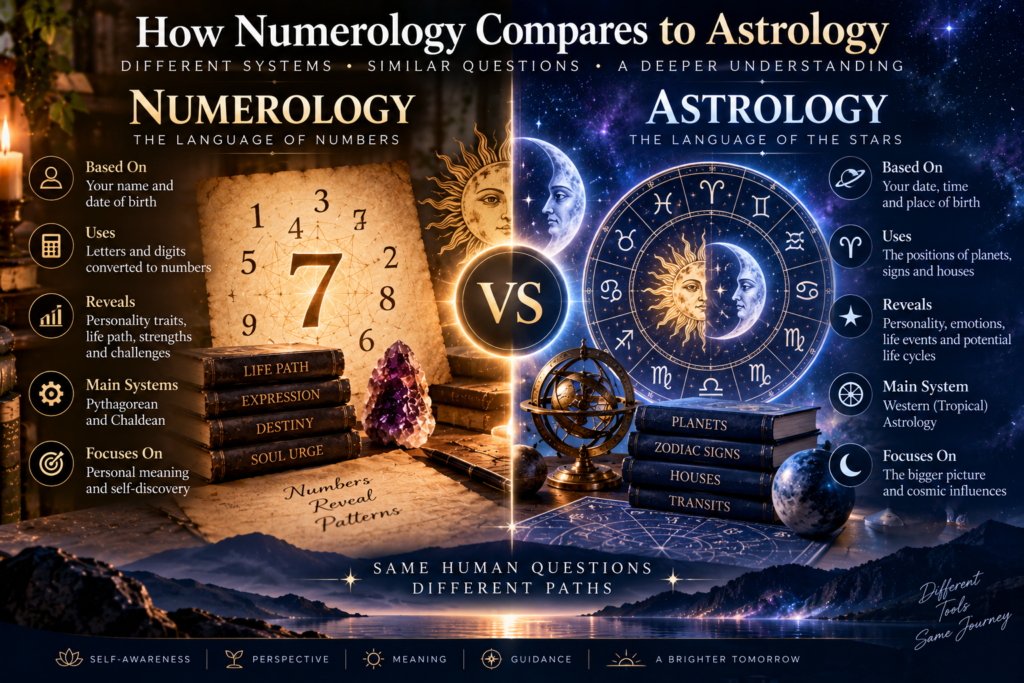
The debate around numerology tracks closely with a similar, older debate around astrology, and the comparison is worth making directly. Both practices assign meaning to something outside a person’s control — a birth date, a set of letters — and both have been tested by researchers using similar methods, with similarly negative results for the specific predictive claims each makes. Both also produce the same psychological experience of feeling personally accurate, driven by the same Barnum effect and confirmation bias mechanisms rather than by any demonstrated connection between the number or sign and the person’s actual traits.
Where they differ somewhat is in cultural weight and historical depth. Numerology, particularly through Chaldean and Vedic traditions, carries deep roots in specific religious and cultural practices across parts of the world, giving it a layer of meaning tied to heritage and tradition that exists independently of whether the calculations themselves hold up scientifically.
What Researchers Actually Say When Asked Directly
When psychologists and researchers are asked directly whether numerology has any predictive validity, the answer tends to be consistent and fairly blunt: no controlled study has found a reliable link between a calculated number and measurable personality traits or life outcomes. This isn’t a case of “not enough research has been done yet” so much as the existing research on closely related belief systems, particularly astrology, having already tested the underlying mechanism and found it doesn’t hold up. Since numerology relies on a similar structure — assigning fixed meaning to something outside a person’s control, based on a date or a name — researchers generally treat the existing findings as applicable to numerology’s core claims as well, even without a large body of numerology-specific studies.
That said, some psychologists distinguish between the predictive claim, which they reject, and the practice’s function as a reflective or ritual tool, which they treat far more generously. A researcher studying belief systems might firmly say Is Numerology Real has a clear “no” as a predictive science, while separately acknowledging that structured self-reflection exercises, numerology included, can produce genuine psychological benefits regardless of whether the underlying numbers carry any independent truth.
Where Belief in Numerology Tends to Come From
Belief in numerology rarely develops from a cold, isolated encounter with a chart. It usually grows out of a specific context — a difficult period where someone is searching for explanation or direction, a cultural or family tradition where numerology was already a normal part of daily decisions, or a moment of genuine surprise when a reading happened to match something real. Understanding this origin matters, because it explains why arguing someone out of a numerology belief with statistics alone rarely works: the belief usually isn’t rooted in a misunderstanding of statistics in the first place, but in a genuine emotional or cultural need the practice happens to meet.
This is also why the question Is Numerology Real tends to generate such different responses depending on who’s asked. Someone who came to numerology during a period of genuine personal meaning-making is answering a fundamentally different question than a researcher evaluating a testable predictive claim, even though both are using the same four words.
So, Is Numerology Real?
Pulling the different threads together: as a scientifically verified system that reliably predicts personality or future outcomes, no credible evidence supports that claim, and the psychological explanations for why it feels accurate are well documented and don’t require the numbers themselves to carry any independent truth. As a structured tool for reflection, a shared cultural language, or a source of comfort and meaning during uncertain moments, its value is real in exactly the same way a thoughtful journaling practice or a meaningful ritual can be real — not because the mechanism is scientifically proven, but because the practice of engaging with it produces a genuine, useful effect on the person doing it.
The most honest answer to Is Numerology Real depends entirely on which question is actually being asked. As a predictive science, the answer is no. As a meaningful practice that shapes how people reflect on themselves, the answer is genuinely yes for the people who engage with it seriously — and both of those answers can sit comfortably next to each other without contradiction.
Frequently Asked Questions
Has numerology ever been scientifically tested?
Numerology-adjacent claims have been tested indirectly through research on similar belief systems like astrology, with results consistently failing to show the predicted traits or outcomes occurring at a rate higher than chance. Numerology specifically hasn’t attracted the same volume of formal research, largely because it isn’t widely treated as a scientific claim worth testing within mainstream research institutions.
Why does numerology feel so accurate to so many people?
This is primarily explained by the Barnum effect, where vague, broadly applicable descriptions feel personally accurate to almost anyone reading them, combined with confirmation bias, where people notice and remember moments that match a description while overlooking moments that don’t.
Is numerology Real considered a religion?
Not typically on its own, though it’s closely tied to religious and spiritual traditions in some cultures, particularly Vedic and Chaldean practices. Many people who use numerology don’t consider it a religious practice at all, treating it instead as a standalone interpretive tradition or personal reflection tool.
Can numerology actually predict the future?
There’s no credible evidence supporting predictive accuracy beyond chance. Most practitioners today, even those who value the practice, tend to frame it as a reflective or symbolic tool rather than a literal predictive system.
What’s the real difference between numerology and astrology?
Both assign personal meaning based on factors outside a person’s control — numerology through names and birth dates, astrology through the position of celestial bodies at birth — and both face the same core scientific criticism. The main practical difference is the specific input each system uses and the particular cultural traditions each one is rooted in.
Should I stop using numerology if it isn’t scientifically proven?
That depends entirely on what you’re using it for. If it’s being treated as a genuine predictive tool for major life decisions, it’s worth being cautious given the lack of supporting evidence. If it’s being used as a reflective exercise or a source of personal meaning, most psychologists would say there’s little harm in continuing, provided it isn’t replacing sound judgment or professional advice where that’s genuinely needed.
Does the answer to this question differ across cultures?
To some degree, yes. In regions where numerology is woven into broader spiritual or astrological traditions passed down through generations, the question Is Numerology Real is often approached less as a scientific claim to test and more as an inherited practice carrying cultural and family significance, similar to other traditions that aren’t typically evaluated through a strictly scientific lens.
Final Thought
Is Numerology Real turns out to be a question with two honest, non-contradictory answers depending on what’s actually being asked. It isn’t a scientifically validated predictive system, and the evidence for that conclusion is fairly clear. But the experience of using it — the reflection it prompts, the language it offers for talking about personality, the sense of meaning some people draw from it — is genuinely real for the people who engage with it, whether or not the underlying mechanism holds up under a microscope.