
Vowels and Consonants in Name Numerology: Soul Urge vs Personality Number
Run your full name through a numerology calculator and you won’t just get one number back. You’ll usually get three: an Expression Number, a Soul Urge Number, and a Personality Number. Most people notice this and assume the extra numbers are just bonus content. They’re not. They come from a single, deliberate design choice buried in how the system works — the split between vowels and consonants.
This is one of the more overlooked parts of numerology, mostly because calculators do the separation automatically and never explain why it matters. Once you understand the logic behind vowels and consonants in name numerology, the three-number structure stops looking arbitrary and starts making a lot more sense.
Why Vowels and Consonants Get Treated Differently at All
Every letter in your name carries a number under either the Pythagorean or Chaldean system. That much is standard. What’s less obvious is that numerologists don’t just add up every letter and call it a day. They split the name into two groups first — vowels and consonants — and calculate each group separately before combining them.
The reasoning goes back to how these two letter types function differently in spoken language. Vowels carry the sound of a word; you can’t pronounce a word without them. Consonants shape and frame that sound but don’t carry it the same way. Early numerologists took this linguistic difference and mapped it onto psychology: vowels, being the “voice” of the name, were treated as a reflection of inner feeling, while consonants, framing the sound from the outside, were treated as a reflection of outward behavior. Whether or not you buy the psychology, this split is the mechanical backbone of three of the most common numbers in a numerology reading.
It also explains why numerology readings feel layered rather than flat. A single combined number would only ever tell you one thing about a name. Breaking the letters into two groups first, then recombining them into a third figure, gives a reading three angles instead of one — an inward angle, an outward angle, and a combined angle that ties the other two together.
The Soul Urge Number: What Vowels Alone Reveal

The first number that comes directly out of separating vowels and consonants in name numerology is the Soul Urge Number, sometimes called the Heart’s Desire Number. To calculate it, you take only the vowels in a name — A, E, I, O, U, and sometimes Y — convert each one to its number using the chosen system, add them up, and reduce the total to a single digit (unless it lands on a master number).
The idea behind this number is fairly direct. Since vowels are treated as the “inner voice” of a name, the Soul Urge Number is meant to reflect internal motivation — what a person actually wants, as opposed to how they present themselves. It’s often described as the number that shows up in private moments rather than public ones.
Here’s a simple example. Take the name “Maria.” The vowels are A, I, A. Under the Pythagorean system, A equals 1 and I equals 9. Add those three values (1 + 9 + 1) and you get 11, which happens to be a master number, so in most systems it would be left unreduced rather than collapsed down to 2. That’s the entire calculation — no consonants involved at any point.
The Personality Number: What Consonants Alone Reveal
On the other side of the vowels and consonants in name numerology split sits the Personality Number. This one works the same way as the Soul Urge Number, except it only uses consonants — every letter in the name that isn’t a vowel.
Where the Soul Urge Number is framed as internal, the Personality Number is framed as external. It’s meant to represent the traits other people notice first: how someone comes across in a first meeting, before anyone has a chance to see what’s underneath. Some numerologists describe it as the “mask” a person wears, not in a dishonest sense, but in the sense of the surface impression that forms before deeper qualities become visible.
Going back to “Maria” as an example: the consonants are M and R. Under Pythagorean numerology, M equals 4 and R equals 9. Add those together and you get 13, which reduces down to 4 (1 + 3). That reduced number becomes the Personality Number for that name, calculated completely independently from the Soul Urge Number above.
The Expression Number: Where Vowels and Consonants Combine
Once you understand vowels and consonants in name numerology as two separate calculations, the third number becomes easy to explain. The Expression Number, sometimes called the Destiny Number, is simply what you get when you add every letter in the full name together — vowels and consonants combined — and reduce the total the same way.
This is often treated as the most complete number of the three, since it draws on the entire name rather than half of it. If the Soul Urge Number reflects inner desire and the Personality Number reflects outward impression, the Expression Number is positioned as the fuller picture that sits behind both — natural talents, general direction, and the qualities a person tends to express across most situations, not just the private or public ones separately.
Mathematically, the Expression Number should always be consistent with the other two. Add the vowel total and the consonant total together, and you’ll land on the same digit sequence as calculating the whole name at once (allowing for the point at which reduction happens). This consistency is a useful way to double-check a manual calculation, since a mismatch between the three numbers almost always points to an error in one of the individual sums.
The Letter Y: Numerology’s Most Debated Case
No discussion of this topic is complete without addressing the letter Y, because it’s the one letter that refuses to sit neatly in either category. In standard English grammar, Y is usually treated as a consonant, but it behaves like a vowel in plenty of common names and words — think “Lynn,” “Kyle,” or “Mary,” where Y is doing the job a vowel normally does.
The letter W causes a smaller version of the same problem in a handful of names, mostly ones with roots outside standard English spelling, though it comes up far less often than Y does. Most calculators default to treating W as a consonant without exception, and disagreements over it are rare compared to the ongoing debate over Y.
Different numerology systems handle this differently, and it’s one of the biggest reasons two calculators can produce different Soul Urge or Personality numbers for the exact same name. Some systems treat Y as a vowel whenever it produces a vowel sound and no other vowel appears in the same syllable. Others simplify things and treat Y as a consonant across the board, no exceptions. A smaller number of systems go the opposite direction and always count it as a vowel.
If you’ve ever compared your numerology results across two different websites and noticed the Soul Urge or Personality Number didn’t match, checking how each site handles Y is usually the fastest way to find the source of the disagreement. It’s rarely a calculation error. It’s almost always a difference in how the split was defined in the first place.
A practical workaround, if you want a consistent answer rather than a debate, is to run the calculation both ways — once treating Y as a vowel, once treating it as a consonant — and note which letters shift between the Soul Urge and Personality totals. For most names, only one or two letters are ever affected, so the range of possible outcomes is usually narrower than it first appears.
How the Pythagorean and Chaldean Systems Handle the Split
This distinction exists in both major numerology systems, but the letter-to-number values underneath it differ, which changes the resulting numbers even when the vowel and consonant grouping itself stays the same.
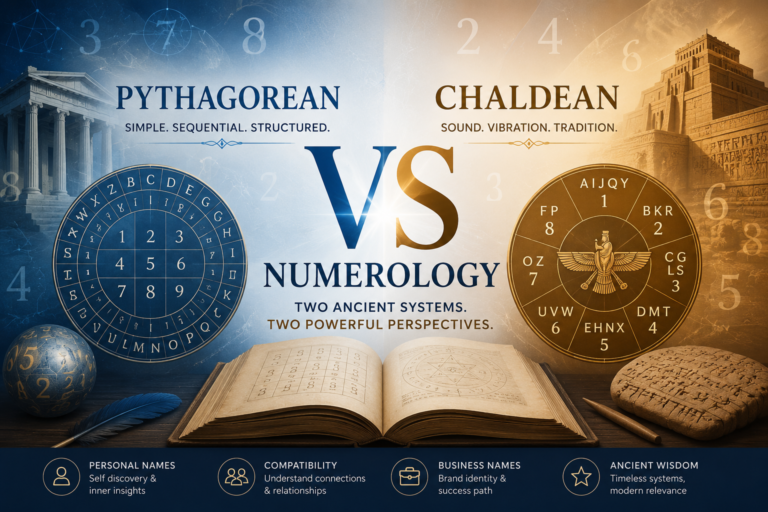
Pythagorean numerology assigns numbers in a simple repeating sequence across the alphabet, so calculating each group separately is mostly a matter of sorting letters into two buckets and adding up values that follow a predictable pattern. Chaldean numerology, by contrast, groups letters according to sound rather than alphabetical position, and it excludes the number 9 from the chart entirely. This means the same name can produce a noticeably different Soul Urge or Personality Number depending on which system generated it, even before the Y letter question comes into play.
Neither approach is more “correct” than the other. They’re two different traditions applying the same basic logic through different letter charts. What matters for consistency is picking one system and sticking with it, particularly if you’re comparing your numbers against someone else’s or tracking changes over time.
There’s also a less common Vedic approach worth a brief mention here, since it doesn’t apply this split in quite the same isolated way. Vedic numerology tends to treat a name as one part of a larger picture that includes birth details and planetary rulership, so the vowel and consonant breakdown, while still present in some Vedic-influenced calculators, carries less weight on its own than it does in the Pythagorean or Chaldean methods.
A Related Concept: The Hidden Passion Number

Once this split is understood, it becomes easier to make sense of a related but less commonly discussed figure: the Hidden Passion Number. This number looks at which digit appears most frequently across all the letters in a name, whether that letter came from the vowel group or the consonant group. It’s not calculated by separating vowels from consonants the way the Soul Urge and Personality numbers are, but it draws on the same underlying letter chart, which is why it tends to show up in the same conversations.
A name with several repeated letters sharing one number value will produce a stronger Hidden Passion reading than a name where every letter maps to a different digit. This is one of the few calculations in numerology where the letters aren’t reduced through addition at all — instead, the calculator is simply counting which number shows up most often across the full spread of letters.
Some numerologists treat the Hidden Passion Number as a secondary insight layered on top of the main three, pointing to a talent or drive that shows up repeatedly across a name without being the dominant theme of any single calculation on its own.
Birth Name Versus Nickname: Which Name Should You Use?
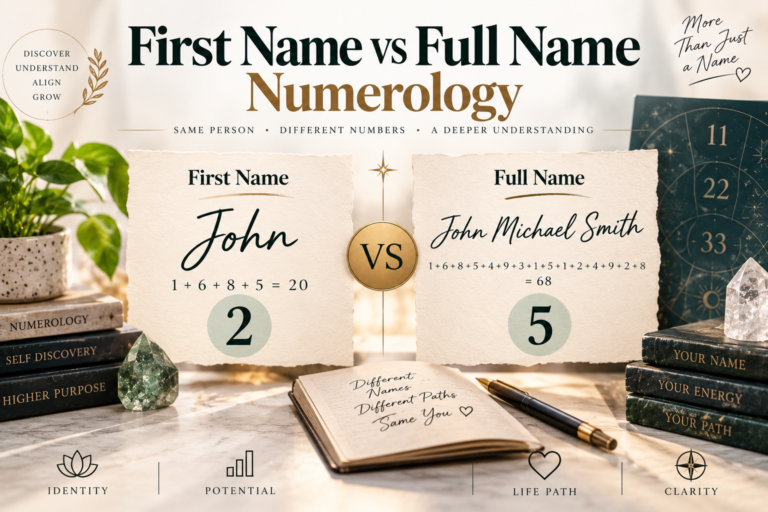
A practical question that comes up constantly once someone understands this split is which version of their name to actually calculate. A full legal birth name will produce a different vowel and consonant split than a shortened nickname, a middle name left out, or a married name added later.
The general convention among numerologists is to use the name given at birth for Soul Urge, Personality, and Expression Number calculations, on the reasoning that this is the name a person’s identity was originally built around. Names used daily, including nicknames, are sometimes calculated separately as a secondary reading, but they’re rarely treated as a replacement for the birth name calculation. This matters specifically because a shorter nickname often has a very different vowel-to-consonant ratio than the full birth name, which can shift the resulting numbers more than people expect.
A Worked Example From Start to Finish
It helps to walk through one full name rather than looking at the two groups as separate, disconnected examples. Take the name “Daniel.”
The letters break down as D, A, N, I, E, L. The vowels are A, I, E. The consonants are D, N, L. Under the Pythagorean chart, A is 1, I is 9, and E is 5, giving a vowel total of 15, which reduces to 6 (1 + 5). That 6 becomes the Soul Urge Number.
The consonants D, N, and L come out to 4, 5, and 3 respectively, for a total of 12, which reduces to 3 (1 + 2). That 3 becomes the Personality Number.
Add the two unreduced totals together — 15 and 12 — and you get 27, which reduces down to 9 (2 + 7). That 9 is the Expression Number, and it should match what you’d get by adding every single letter in “Daniel” together from scratch and reducing the total in one pass. Working through a name this way, step by step, makes the relationship between the three numbers far easier to hold onto than reading the definitions alone.
Common Mistakes People Make With This Calculation
A few errors show up repeatedly when people try to work out vowels and consonants by hand instead of relying on a calculator. The most frequent one is forgetting to decide on a Y policy before starting, which throws off both totals inconsistently depending on where the letter falls in the name. The second most common mistake is reducing each individual letter down to a single digit before adding, rather than adding the raw letter values first and reducing only the final sum — a shortcut that can accidentally produce a different result than the standard method.
A third mistake worth flagging is mixing systems mid-calculation, using a Chaldean value for one letter and a Pythagorean value for another simply because those were the numbers remembered from different sources. None of these mistakes are complicated to avoid once you know to watch for them, but they’re common enough that double-checking a manual calculation against an online tool is usually worth the extra minute.
Putting It Together: Reading All Three Numbers as One Picture
The real value in understanding vowels and consonants in name numerology isn’t memorizing the mechanics of each calculation. It’s being able to read the three resulting numbers as pieces of one connected picture rather than three unrelated facts.
The Soul Urge Number, built from vowels, points inward. The Personality Number, built from consonants, points outward. The Expression Number, built from the full name, sits above both as the combined total. Reading them together — rather than picking whichever one sounds most flattering — gives a more complete version of what a name numerology reading is actually meant to offer: a look at internal motivation, external impression, and overall direction, all coming from the same set of letters, split apart on purpose rather than by accident.
That split is the entire reason vowels and consonants in name numerology exists as a separate step in the first place, rather than a single letter-count applied once and left at that.