Master Numbers in Numerology Explained: 11, 22, and 33 Meaning
Every number in a standard numerology chart eventually gets reduced down to a single digit between 1 and 9. Add up the letters in a name, add up the digits in a birth date, and whatever total you land on, you keep adding the digits together until only one is left. Except for three numbers. Master numbers in numerology break this rule on purpose, and understanding why they get special treatment says a lot about how the whole system is built.
If you’ve ever calculated your Life Path Number and landed on 11, 22, or 33 instead of a single digit, you’ve already run into one of these. This article walks through what master numbers in numerology actually are, where the concept came from, what each of the three represents, and a few of the misconceptions that tend to follow people around once they find out they have one in their chart.
What Makes a Number “Master” in the First Place
To understand master numbers in numerology, it helps to first understand the rule they’re breaking. Standard numerology reduction takes any multi-digit total and keeps adding its digits together until a single number remains. The number 47 becomes 11 (4+7), and normally that 11 would get reduced one step further into 2 (1+1). That final step is where master numbers step outside the usual pattern — the reduction stops early, and the double-digit number is kept intact instead of being collapsed down further.
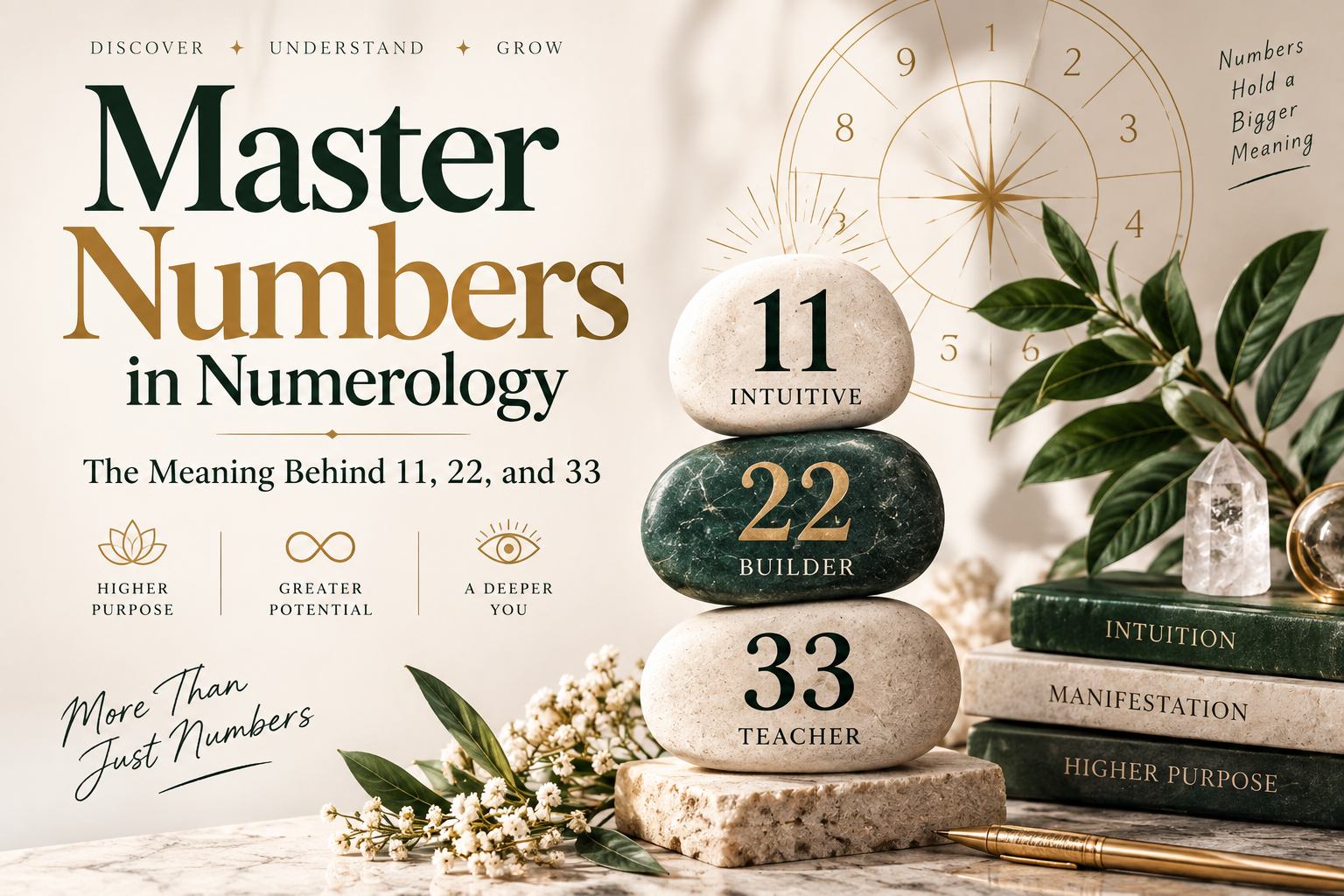
This applies to exactly three numbers within the standard 1-through-9 framework: 11, 22, and 33. Some numerologists extend the idea to 44, 55, and beyond, though this is far less standard and not something most calculators apply by default. The three widely recognized master numbers in numerology are 11, 22, and 33, and each one carries its own distinct meaning rather than simply being treated as “more” of whatever the reduced single digit would represent.
The logic behind leaving them unreduced comes down to intensity. A number like 2 represents balance and cooperation in a fairly ordinary sense. The number 11, which would reduce to 2, is treated as carrying that same core theme but at a significantly higher pitch — sharper insight, stronger sensitivity, and a kind of pressure that an ordinary 2 doesn’t carry. Reducing it down would flatten that intensity into something more common, so the system leaves it alone instead.
Where the Concept of Master Numbers Came From
The idea of master numbers in numerology isn’t part of the earliest layers of the practice. Ancient systems like Chaldean numerology and the original Pythagorean framework didn’t formally set aside 11, 22, and 33 as separate categories the way modern numerology does. The concept took its current shape mostly during the 20th century, alongside the broader formalization of Life Path Number calculations and the general packaging of numerology into the structured system most people recognize today.
This matters because it explains why the concept sometimes feels like a slightly separate layer bolted onto an older foundation, rather than something baked into the practice from the very beginning. The underlying belief that certain numbers carry weight goes back thousands of years, but the specific framing of 11, 22, and 33 as “master” numbers is a much newer addition, shaped by numerologists working to standardize the field for a modern audience.
Master Number 11: The Intuitive
The first of the three master numbers in numerology is 11, often described as the most intuitive number in the entire system. Where a reduced 2 represents diplomacy, patience, and partnership, an unreduced 11 is described as carrying those same qualities but layered with heightened sensitivity, sharper instincts, and an unusually strong pull toward insight that goes beyond what can be explained logically.
People associated with an 11 in their chart are often described as perceptive to the point of discomfort, picking up on things in a room or a conversation before anyone else notices. This sensitivity is framed as a gift, but numerologists are quick to point out that it comes with real difficulty attached. Heightened perception without an outlet can turn into anxiety or self-doubt, and much of what’s written about the 11 focuses on learning to trust that instinct rather than being overwhelmed by it.
Master Number 22: The Builder

The second of the three master numbers in numerology is 22, commonly labeled the “Master Builder.” A reduced 4 represents structure, discipline, and practical effort. The unreduced 22 is described as taking that same foundation and pairing it with the intuitive depth of the 11, producing someone capable of turning large, abstract ideas into real, tangible results.
This is often presented as the most outwardly impactful of the three master numbers, associated with people who build something lasting — a business, an institution, a body of work — rather than simply having good ideas. The flip side, according to most numerology writing on the subject, is pressure. An unreduced 22 in a chart is frequently described as carrying high expectations, both from others and from the person themselves, and a tendency toward burnout if that drive for large-scale results isn’t balanced with rest.
Master Number 33: The Teacher
The third and rarest of the three master numbers in numerology is 33, known as the “Master Teacher.” A reduced 6 already represents nurturing, responsibility, and care for others. The unreduced 33 is described as amplifying that theme into something closer to selfless service — a pull toward guiding, healing, or teaching others that goes beyond typical caretaking.
Because 33 requires a very specific combination of digits to appear in a calculation, it’s considered the least common of the three, and some numerologists argue it rarely shows up in a Life Path Number calculation at all without both an 11 and a 22 already present somewhere in the birth date. Whether or not that specific claim holds across every system, the general agreement is that 33 is treated as the most demanding of the three master numbers in numerology, carrying a weight of responsibility that’s framed as both a strength and a genuine burden.
Master Numbers Beyond the Life Path Number
Most conversations about these numbers focus on the Life Path Number, since that’s the calculation most people check first. But 11, 22, and 33 can appear in other calculations too, including the Expression Number and the Soul Urge Number, both of which are built from a person’s name rather than their birth date.
When a master number shows up in the Expression Number, it’s generally read as describing talent and potential rather than inner drive — the shape of what someone is naturally capable of producing in the world. When it shows up in the Soul Urge Number, calculated from the vowels in a name, it’s read closer to internal motivation, an unusually strong pull toward whatever theme that particular master number represents. The interpretation shifts slightly depending on which calculation produced it, even though the core meaning of the number itself stays consistent.
A Common Misconception Worth Addressing
One of the biggest misunderstandings around master numbers in numerology is the assumption that having one automatically means a more fortunate or more special life path than someone with a standard single-digit number. Most serious numerology writing pushes back on this directly. A master number isn’t framed as a reward. It’s framed as intensity — a heavier version of an already meaningful theme, with real difficulty built into the package alongside whatever potential comes with it.
This distinction matters because it changes how someone should actually approach discovering a master number in their own chart. Treating it as an automatic sign of destiny or superiority tends to set up unrealistic expectations. Treating it as a pattern that comes with both strong potential and real challenges tends to be a far more accurate reading of what most numerology sources actually say about the subject.
How Master Numbers Get Calculated Without Being Reduced
Here’s where the mechanics matter. A standard Life Path Number calculation adds together the digits of a full birth date and reduces the total step by step until one digit remains — except that if the running total lands on 11, 22, or 33 at any point during that reduction, the process stops there instead of continuing.
Take a birth date that adds up to 29 at some stage of the calculation. Under normal rules, 29 would reduce to 11 (2+9), and that 11 would then reduce further to 2 (1+1). Because 11 is one of the recognized master numbers in numerology, most systems stop the reduction the moment 11 appears, rather than continuing on to the final 2. This is the exact mechanical rule that separates a master number result from a standard one, and it’s the reason two people whose birth dates both technically “add up to 2” can end up with very different chart readings — one reduced all the way down, one stopped early at 11.
Karmic Debt Numbers: A Related But Separate Concept
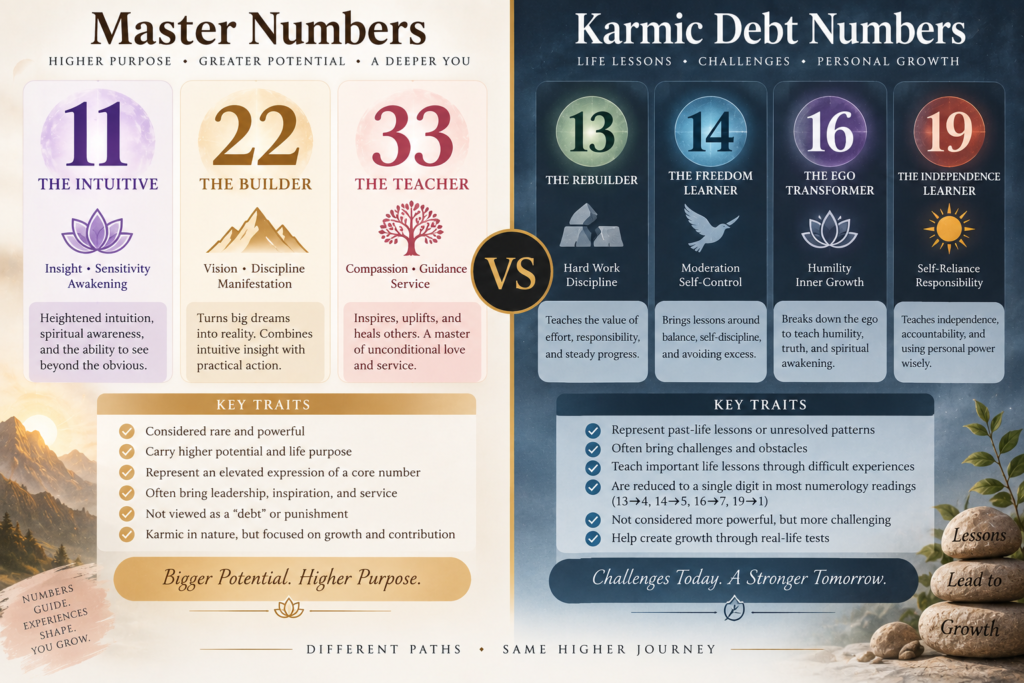
A concept that frequently gets confused with this idea is karmic debt numbers — specifically 13, 14, 16, and 19. These numbers work in the opposite direction. Rather than being preserved because they carry extra strength, karmic debt numbers are flagged during a calculation because certain numerology traditions treat them as carrying unresolved lessons or challenges from a past pattern that needs to be worked through.
The confusion between the two categories is understandable, since both involve a numerology calculator flagging a specific number partway through a normal reduction process. But the underlying meaning is close to opposite. Master numbers in numerology are treated as amplified strength paired with real pressure. Karmic debt numbers are treated as a challenge to resolve rather than a strength to lean into. Keeping the two concepts separate avoids a fairly common mix-up in how people interpret their own numerology chart.
Reading a Master Number in Context, Not Isolation
A well-built numerology chart doesn’t rely on a single number to describe an entire person, and these amplified figures are no exception to that. An 11 as a Life Path Number sits alongside an Expression Number, a Soul Urge Number, and a Personality Number, all calculated separately and all contributing to the overall picture. Reading a master number in isolation, without looking at how it interacts with everything else in the chart, tends to produce an oversimplified interpretation.
This is worth keeping in mind particularly because master numbers tend to attract outsized attention compared to standard single-digit numbers, simply because they’re rarer and carry a more dramatic reputation. A complete reading treats the master number as one significant piece among several, not the entire story on its own.
Master Number 44 and Why Most Systems Leave It Out
A question that comes up often once someone learns about 11, 22, and 33 is whether the pattern continues upward — what about 44, or 55? A small number of modern numerologists do argue for extending the master number category beyond the traditional three, treating 44 in particular as a fourth master number tied to themes of stability, discipline, and long-term structure built through hard work.
Most mainstream calculators and traditional numerology sources don’t follow this extension, though. The three widely accepted numbers remain 11, 22, and 33, and treating 44 as a fourth is generally considered a newer, less standardized idea rather than an established part of the core system. If a calculator or numerologist tells you a number beyond 33 is a master number, it’s worth knowing that this isn’t universally agreed upon, and other equally credible sources would simply reduce that number down like any other.
A Worked Example: Finding a Master Number in a Birth Date
Walking through a real calculation makes the concept easier to hold onto than reading the theory alone. Take a birth date of November 29, 1992.
Written numerically, that’s 11/29/1992. Add every individual digit together: 1+1+2+9+1+9+9+2, which comes to 34. Reduce 34 by adding its digits: 3+4, giving 7. In this case, the calculation never touches 11, 22, or 33 at any stage, so the final Life Path Number is a standard 7, with no special stopping point along the way.
Now compare that to a birth date of February 9, 1994. Written numerically, that’s 2/9/1994. Add the digits: 2+9+1+9+9+4, which comes to 34 as well — but the order of addition matters here depending on which method a calculator uses. Some systems add the month, day, and year separately before combining totals, rather than adding every single digit in one long string. Under a method that adds the day and year separately before combining, a birth date landing on an intermediate total of 29 for the day would first reduce to 11 (2+9), and because 11 is one of the recognized stopping points, many calculators would preserve that 11 in the day’s contribution to the final chart rather than reducing it all the way to 2.
This is exactly why it’s worth checking how a specific calculator explains its method before assuming a result is wrong. Two different tools can process the same birth date through slightly different addition orders and arrive at different conclusions about whether a master number appears at all.
Are Master Numbers Becoming More Common Today?
An observation that shows up periodically in numerology circles is the claim that master numbers seem to be appearing more frequently in recent birth dates than they did in past decades, particularly tied to years like 1999, 2000, and other dates with repeating digit patterns. Numerologists who make this claim usually point to the mathematics of certain calendar years producing more totals that land on 11 or 22 before final reduction, simply because of how those specific digits combine.
This isn’t universally accepted as meaningful, and skeptics point out that it’s a fairly predictable side effect of calendar math rather than a shift in anything deeper. Still, it’s a common enough talking point in modern numerology writing that it’s worth mentioning as part of a fuller picture of how the concept gets discussed today.
Final Thoughts
Master numbers in numerology exist because the system’s designers decided that certain totals carry too much weight to be flattened down through standard reduction. The 11, the 22, and the 33 each represent an amplified version of a simpler underlying theme — intuition, structure, and service, respectively — paired with a level of pressure that most single-digit numbers don’t carry in the same way. Understanding that trade-off, rather than treating a master number as a simple stroke of luck, is what separates a grounded reading from an oversimplified one.
Whether a master number shows up in a Life Path calculation, an Expression Number, or a Soul Urge Number, the underlying idea stays the same: something in the chart was strong enough that the system chose not to reduce it any further.