First Name vs Full Name Numerology: Which One Should You Calculate?
Type your first name into a numerology calculator, then type your full legal name into the same calculator, and you’ll almost never get the same number twice. This catches people off guard more often than any other part of the process, mostly because nobody warns them ahead of time that the choice of which name to use actually changes the outcome. First name vs full name numerology isn’t a minor technical detail. It’s one of the first decisions that shapes everything a reading tells you.
This article walks through why the two versions produce different results, which one numerologists generally recommend, and how to handle the messier real-world cases — nicknames, married names, and names that changed at some point in a person’s life.
Why the Choice of Name Actually Changes the Number
Every numerology calculation, whether it’s the Expression Number, the Soul Urge Number, or the Personality Number, works the same basic way. Each letter in a name gets converted into a digit, those digits get added together, and the total gets reduced down to a single number, unless it lands on a master number like 11, 22, or 33. The math itself never changes. What changes is the input.
This is the entire reason first name vs full name numerology produces different results for the same person. A first name alone might be five or six letters. A full legal name, including middle names and a surname, could easily be three or four times longer. More letters means a different sum, which means a different reduced total, which means a different number showing up on the chart. It’s not that one calculation is right and the other is wrong — they’re simply working with different amounts of information.
What Numerologists Traditionally Recommend

Most established numerology practice comes down firmly on one side of the first name vs full name numerology question: use the complete name given on the birth certificate. This includes the first name, any middle names, and the original surname a person was born with, regardless of what they go by in daily life.
The reasoning behind this recommendation isn’t really about accuracy in a scientific sense — numerology doesn’t operate on that kind of evidence. It’s about the idea that a birth name represents the identity a person was originally assigned, before nicknames, marriages, professional rebranding, or personal preference altered how that name gets used day to day. Numerologists who favor the full birth name argue that this is the version most closely tied to a person’s core identity, and that using anything shorter risks producing an incomplete reading.
This is why most name numerology calculators, including thorough ones, ask for a full name rather than just a first name when generating an Expression Number, a Soul Urge Number, or a Personality Number. The first-name-only version isn’t treated as wrong, exactly, but it’s generally treated as partial.
What Gets Lost When You Only Use a First Name
Looking at first name vs full name numerology side by side makes it easier to see what’s actually missing when someone calculates only their first name. A first name captures one slice of a person’s identity, but it leaves out the surname entirely, along with any middle names.
Numerologists who work with full names argue that surnames carry meaning too, often tied to family lineage or inherited traits, and that leaving a surname out of the calculation removes a layer of context the reading is meant to include. Middle names, when present, are treated the same way — smaller in weight than a first or last name in most interpretations, but still contributing letters to the total rather than being irrelevant.
A first-name-only calculation isn’t useless. It can still produce a valid Expression Number for that specific slice of a name, and some readings intentionally focus on just the first name to explore a narrower question, like how a person presents themselves in casual, first-impression settings. But it’s a different question than what a full name calculation is answering, and conflating the two is where a lot of confusion about mismatched results comes from.
Nicknames: A Special Case Within First Name vs Full Name Numerology

Nicknames complicate first name vs full name numerology even further, because a nickname isn’t simply a shortened first name — it’s often a completely different set of letters. Someone born “Elizabeth” who goes by “Beth” or “Liz” daily is working with a name that shares almost nothing structurally with the original beyond a handful of letters.
Most numerologists treat a nickname reading as a secondary calculation rather than a replacement for the birth name reading. The logic is similar to why the full legal name gets priority over a first name alone: a nickname reflects how a person is known socially, which can be useful information, but it isn’t treated as the foundational identity number the way a birth name is. Some numerology writing frames a nickname calculation as showing how a person is perceived by others day to day, distinct from the deeper Expression Number tied to their full birth name.
Married Names and Legal Name Changes
Marriage is probably the most common real-world scenario that forces people to think seriously about first name vs full name numerology, since it usually changes at least the surname and sometimes more. A person who takes a spouse’s last name is, from a numerology standpoint, now working with a name that differs from the one they were born with.
There’s genuine disagreement among numerologists here. Some argue the birth name should always remain the primary calculation, since it represents the original identity a person carried into the world, with the married name treated as a secondary influence layered on top. Others argue that a name used consistently for decades, married or not, develops its own numerological weight over time and deserves to be treated as the primary version going forward. Neither position is universally accepted as the single correct approach, which is part of why two different numerologists can give a married client genuinely different readings depending on which name they prioritize.
A practical middle ground that shows up often in numerology writing is calculating both the birth name and the current legal name, then treating the birth name as the deeper, more permanent baseline and the current name as a reflection of how life has shifted since then.
Maiden Names and Comparison Readings
A related use case involves maiden names specifically, often calculated for comparison purposes rather than as a primary reading. Someone curious about how their numerology profile changed after marriage might calculate both their maiden name and their married name side by side, looking at the shift in Expression Number, Soul Urge Number, and Personality Number as a way of understanding what changed and what stayed consistent.
This kind of comparison isn’t typically presented as one version being more accurate than the other. It’s framed more as tracking a transition, similar to how someone might look at two photographs of the same place years apart to see what changed.
Middle Names: Included or Optional?
Middle names sit in a slightly gray area within this decision. Most numerologists who recommend the full birth name do include middle names in the calculation, treating them as part of the complete identity given at birth, even if they carry less day-to-day visibility than a first or last name.
That said, some simplified calculators skip middle names entirely and calculate only a first and last name, partly for convenience and partly because a significant number of people don’t know their exact recorded middle name well enough to spell it with full confidence. When comparing results across different calculators, checking whether middle names were included is a useful first step before assuming there’s an error somewhere in the math.
How This Affects the Three Core Numbers Differently
The first name vs full name numerology decision doesn’t affect every calculation equally. The Expression Number, built from every letter in whatever name version is chosen, shows the most dramatic shift between a first-name-only calculation and a full-name calculation, simply because the letter count changes the most.
The Soul Urge Number, built only from vowels, and the Personality Number, built only from consonants, still shift between the two name versions, but sometimes by a smaller margin, depending on how many vowels or consonants happen to sit in the surname compared to the first name vs full name numerology. A surname with very few vowels, for instance, might barely move the Soul Urge Number even though it noticeably changes the Expression Number. This is worth knowing before assuming a large or small shift between name versions means something went wrong in the calculation.
A Practical Way to Decide Which Version to Use
Given how much disagreement exists around first name vs full name numerology, it helps to have a simple, practical approach rather than trying to resolve every debate a professional numerologist might have. For a foundational, one-time reading, calculating the complete birth certificate name — first, middle, and last — lines up with what most traditional numerology sources recommend.
For anyone specifically curious about how a nickname, married name, or professional name compares, calculating that version separately and treating it as additional context, rather than a replacement, tends to avoid the confusion that comes from mixing and matching results across different name versions in a single reading. Keeping the two calculations distinct, and being clear about which one produced which number, solves most of the confusion that first name vs full name numerology tends to create for people running these numbers for the first time.
A Worked Example: Same Person, Two Different Numbers
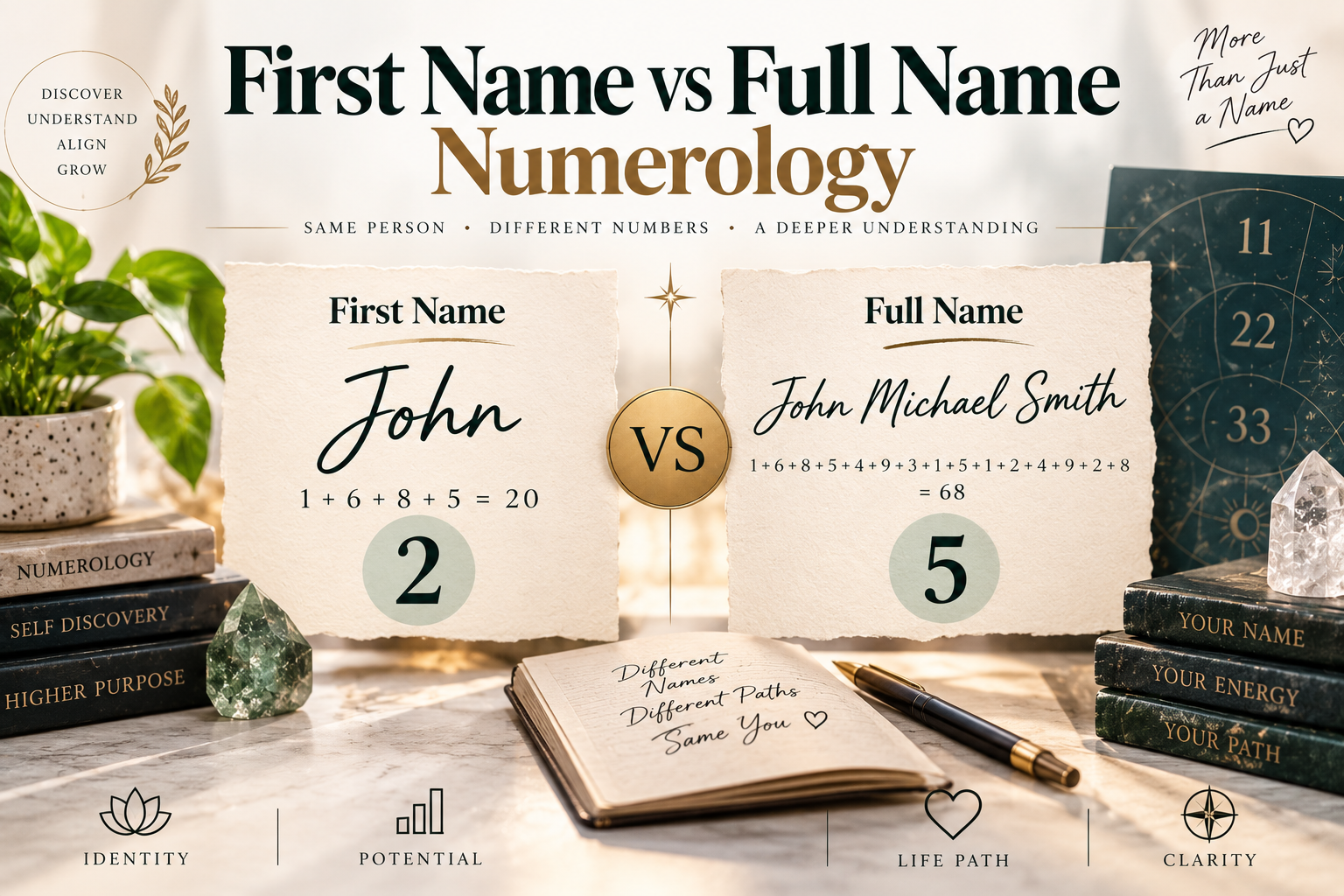
It helps to see the gap in first name vs full name numerology through an actual calculation rather than just the concept. Take someone named “John Michael Smith,” who goes by “John” in everyday life.
Calculating just the first name “John” under the Pythagorean system: J is 1, O is 6, H is 8, N is 5. Add those together and you get 20, which reduces to 2 (2+0). That 2 becomes the Expression Number for the first-name-only version.
Now calculate the full birth name, “John Michael Smith.” Adding every letter across all three names produces a considerably larger total before reduction — in this case, the full sum comes to 68, which reduces to 5 (6+8=14, then 1+4=5). The first-name-only calculation lands on 2. The full-name calculation lands on 5. Same person, same alphabet, same numbering system — two completely different Expression Numbers, purely because of how much of the name was included in the sum.
This is the clearest illustration of why the debate exists at all. Neither 2 nor 5 is a wrong answer. They’re answers to two different questions: what does “John” alone express, versus what does the complete identity given at birth express.
Professional Names and Stage Names
A less commonly discussed angle here involves professional names — stage names, pen names, or a shortened business-facing version of a longer birth name. Performers, writers, and public figures often go by a name that differs meaningfully from what’s on their birth certificate, sometimes dropping a surname entirely or adopting one that was never legally theirs.
Numerologists who work with clients in these situations typically treat the professional name similarly to how they treat a nickname: worth calculating as a secondary reading that reflects how a person is perceived in a specific public-facing context, without replacing the deeper birth-name calculation. The reasoning stays consistent with everything else in this discussion — the birth name is treated as foundational, and every other version of a name adds a layer of context on top of that foundation rather than overwriting it.
What Happens When You Don’t Know Your Exact Birth Name
A practical problem that occasionally comes up in this comparison is simpler than any of the interpretive debates above: some people genuinely don’t know the exact spelling of their full name as recorded on their birth certificate, particularly for middle names or historical spelling variations in a family surname.
In these cases, most numerologists recommend using the most complete and accurate version a person can confirm, rather than guessing at an exact legal record. A close approximation of the full name still captures far more of the identity picture than deliberately calculating only a first name, even if a middle initial or an old spelling variant can’t be confirmed with total certainty. The goal is completeness where possible, not perfection at the expense of ever getting a reading done at all.
Does the Order of Names Matter Too?
A smaller detail that occasionally comes up alongside this comparison is whether the order of names in a calculation makes any difference. Since numerology addition is commutative in the mathematical sense — the order digits get added in doesn’t change the final sum — most numerologists agree that whether “John Michael Smith” is calculated as first-middle-last or in any other order, the Expression Number itself won’t change, because every letter still contributes the same value to the same total regardless of position.
Where order can matter is in more specialized readings that look at individual name segments separately rather than combining them into one sum — for instance, comparing a first name’s contribution against a surname’s contribution side by side rather than adding them together. In that kind of layered reading, which segment comes first in the presentation doesn’t affect the math, but it can affect which part of the analysis gets emphasized first when a numerologist walks a client through the results.
A Simple Checklist Before Running Your Own Calculation
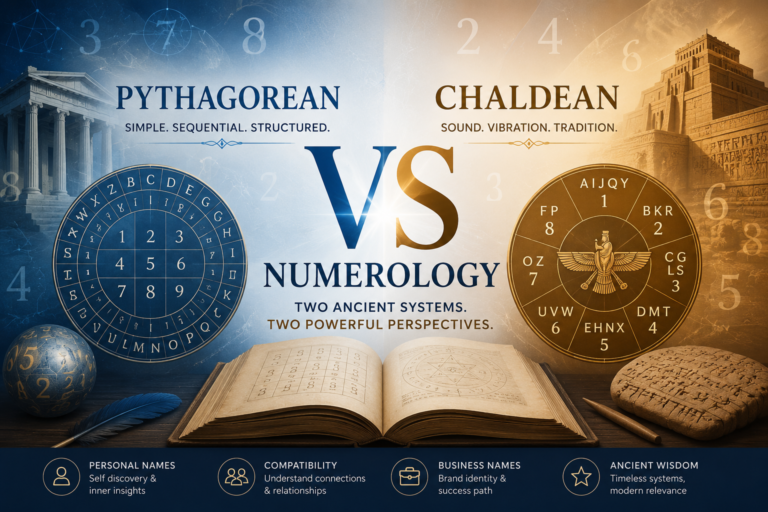
For anyone about to run their own numbers, a short checklist tends to prevent most of the confusion that this decision otherwise creates. Confirm the exact spelling of the birth certificate name, including any middle names, before starting. Decide upfront whether a secondary reading using a nickname, married name, or professional name is wanted alongside the primary calculation, rather than mixing versions midway through. Keep note of which numerology system, Pythagorean or Chaldean, is being used, since switching systems partway through a comparison produces results that can’t be meaningfully compared to each other. Following these steps in order, before typing anything into a calculator, tends to produce a cleaner, more consistent reading than approaching the process without a plan.
Final Thoughts
The gap between first name vs full name numerology isn’t a flaw in the system — it’s a direct result of how the calculation works, where more letters simply produce a different total than fewer letters. Traditional numerology leans toward using the complete birth name as the primary reading, treating shorter versions like a first name or nickname as secondary or supplementary rather than a full replacement.
Whichever version gets used, consistency matters more than picking a single “correct” answer. A reading built on a full birth name and a reading built on a first name alone are answering slightly different questions, and knowing which question is being asked is what actually makes the resulting number worth paying attention to.