
Understanding Chaldean Numerology: The Complete Beginner’s Guide
Most people’s first exposure to numerology comes through the simple, sequential version — A is 1, B is 2, and so on. Fewer people ever encounter the older, stranger system sitting underneath it: Chaldean numerology, where letters get grouped by how they sound rather than where they sit in the alphabet. Understanding Chaldean numerology means letting go of the assumption that every numerology chart works the same way, because this one genuinely doesn’t.
This guide walks through where the system came from, how its letter chart actually works, why the number 9 is missing from it entirely, and how to calculate a name using it yourself.
🏺 Where It Came From
Understanding Chaldean numerology starts with a place, not a person. Unlike Pythagorean numerology, which carries the name of a specific Greek philosopher, the Chaldean system traces back to the Chaldeans of ancient Babylon — priest-astronomers who studied the movement of stars and planets as part of the same worldview that shaped their number symbolism.
A short timeline helps here:
| Period | Development |
|---|---|
| ~3,000+ years ago | Chaldean priests in Babylon link number symbolism to astronomical observation |
| Later antiquity | The sound-based letter-to-number system spreads through trade and scholarly exchange |
| Modern era | Chaldean numerology gets documented and formalized alongside other traditions during the 20th-century standardization of numerology |
This origin matters for one practical reason: Chaldean numerology predates the more commonly used Pythagorean system by a wide margin, and understanding that history explains why the two charts don’t agree with each other. They weren’t built by the same people, in the same era, or with the same logic.
🔤 The Chart Itself: Sound Over Sequence
Here’s the part that actually separates this system from every other letter-based numerology method. Understanding Chaldean numerology requires understanding one core design choice: letters aren’t numbered in order. They’re grouped by the sound they produce when spoken.
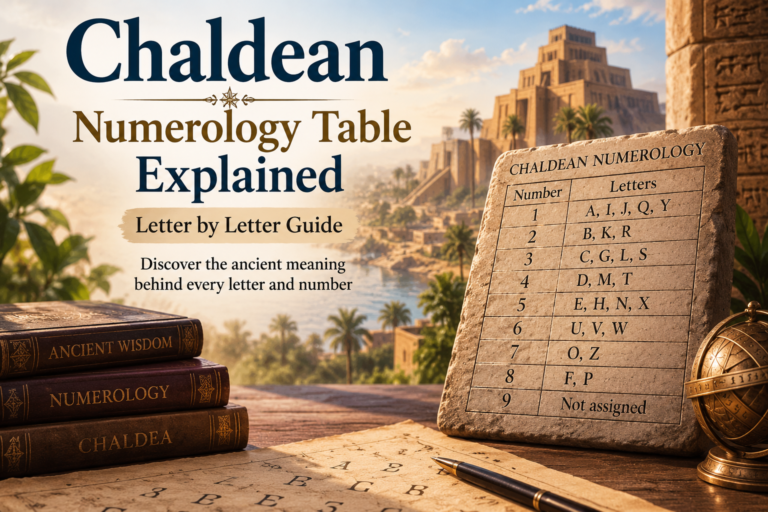
The Chaldean letter-to-number chart:
| Number | Letters |
|---|---|
| 1 | A, I, J, Q, Y |
| 2 | B, K, R |
| 3 | C, G, L, S |
| 4 | D, M, T |
| 5 | E, H, N, X |
| 6 | U, V, W |
| 7 | O, Z |
| 8 | F, P |
| 9 | (not used) |
Notice two things immediately. First, the groupings look uneven — some numbers get five letters, others get only two. Second, and more strikingly, 9 doesn’t appear anywhere on the chart.
Neither of these is an accident or an oversight.
❓ Why the Number 9 Disappears
This is probably the single most-asked question by anyone genuinely trying to work through understanding Chaldean numerology for the first time: where did 9 go?
Ancient Chaldean tradition treated 9 as too sacred, too powerful, or too complete to assign to any single letter. Some historical explanations tie this to 9 representing totality or divinity — a number reserved for the universe itself rather than handed out to an individual letter. Whatever the exact original reasoning, the practical result is consistent across every legitimate Chaldean chart: 9 is excluded from letter assignment entirely, though it can still appear as a final calculated total once letter values are added together.
This distinction trips people up constantly. A letter is never worth 9. A calculated name total absolutely can be.
🧮 How to Actually Calculate a Name

Understanding Chaldean numerology on paper is one thing. Running an actual calculation is where the system starts to feel real. Here’s the process, broken into clear steps:
- Write out the full name you’re calculating (birth name is the traditional recommendation)
- Assign each letter its Chaldean number using the chart above
- Add all the values together to get a raw total
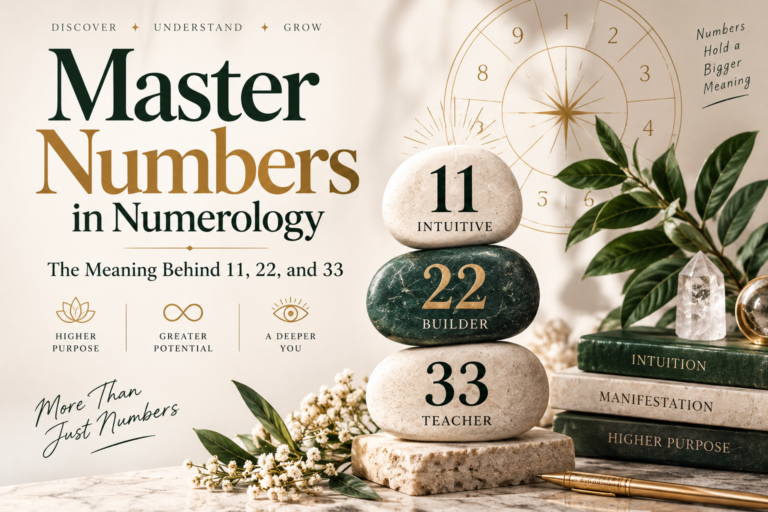
- Reduce the total by adding its digits together, repeating until you reach a single digit — unless the total is a master number (11, 22, or 33), which most systems leave unreduced
Worked Example: “Sara”
| Letter | S | A | R | A |
|---|---|---|---|---|
| Value | 3 | 1 | 2 | 1 |
Add the values: 3 + 1 + 2 + 1 = 7. Since 7 is already a single digit, no further reduction is needed. Under the Chaldean system, “Sara” produces a core number of 7.
Worked Example: “Michael”
| Letter | M | I | C | H | A | E | L |
|---|---|---|---|---|---|---|---|
| Value | 4 | 1 | 3 | 5 | 1 | 5 | 3 |
Add the values: 4+1+3+5+1+5+3 = 22. Because 22 is a recognized master number, most Chaldean readings would preserve it rather than reducing it further to 4 (2+2).
⚖️ Chaldean vs Pythagorean: A Side-by-Side Look
A big part of understanding Chaldean numerology is understanding Chaldean numerology what it isn’t — namely, the more commonly used Pythagorean system. Laid out directly:
| Factor | Chaldean | Pythagorean |
|---|---|---|
| Origin | Ancient Babylon | Ancient Greece |
| Letter logic | Grouped by sound | Sequential (A=1, B=2, C=3…) |
| Number 9 | Excluded from the chart | Included like any other digit |
| Typical modern use | Business names, traditional readings | Personal names, most Western calculators |
| Learning curve | Requires memorizing an uneven chart | Easy to reconstruct from memory |
Run the same name through both systems and you’ll typically get two different numbers — not because one calculator is broken, but because the two systems were never designed to agree with each other in the first place.
🕌 Why It’s Still Used for Business Names
One detail worth pulling out on its own: many practitioners of Chaldean numerology specifically recommend it for business and brand names rather than personal names. The reasoning traces back to the system’s historical association with trade and commerce in the ancient world, where Chaldean merchants and traders were already applying number symbolism to transactions and agreements long before it became a personal-identity tool.
This is a genuinely useful thing to know if you’ve ever wondered why a numerologist might use one system for your personal name reading and a different one when naming a company. Understanding Chaldean numerology in this context isn’t just academic history — it explains a real, ongoing practice in how the system gets applied today, particularly across South Asia, where Chaldean-influenced business naming consultations remain common.
🌏 Regional Popularity: Where This System Still Dominates
Understanding Chaldean numerology also means understanding where in the world it’s actually used most. While Pythagorean numerology tends to dominate Western apps and calculators, Chaldean numerology has maintained a much stronger foothold across South Asia, particularly in India, Pakistan, and parts of the Middle East, where it’s frequently paired with Vedic astrology rather than treated as a standalone practice.
This regional split isn’t accidental. Vedic numerology traditions, which developed alongside Indian astrology, absorbed a good deal of Chaldean logic over the centuries as trade routes connected Babylon with South Asia. The result is a numbering system that, while technically distinct from formal Vedic numerology, shares enough structural DNA that many practitioners in the region use the terms somewhat interchangeably, or blend elements of both into a single consultation.
A practical consequence of this: if you’re searching for a name numerology calculator built specifically for a South Asian audience, there’s a reasonable chance it defaults to a Chaldean-based chart rather than the Pythagorean one more common on Western-built sites. This is one of the more overlooked pieces of understanding Chaldean numerology as a living, regionally distinct practice rather than a purely historical curiosity.
🔢 What the Individual Numbers Are Said to Mean

Once a name has been reduced down to a single digit (or preserved as a master number), the Chaldean tradition assigns each result a specific meaning, similar in spirit to Pythagorean interpretations but with some notably different emphases.
| Number | Chaldean Association |
|---|---|
| 1 | Leadership, independence, a strong individual will |
| 2 | Sensitivity, partnership, diplomatic instinct |
| 3 | Communication, creativity, a tendency toward self-expression |
| 4 | Structure, discipline, and a practical, grounded approach |
| 5 | Adaptability, restlessness, a pull toward freedom and change |
| 6 | Responsibility, nurturing, a strong pull toward home and family |
| 7 | Introspection, analysis, a tendency to question rather than accept |
| 8 | Ambition, material achievement, and an association with power |
| 9 | (Never assigned to a letter, but can appear as a final total) — associated with completion and universal themes when it does appear |
Reading these meanings alongside the letter chart is where Chaldean numerology moves from a purely mechanical exercise into the interpretive side most people actually come looking for. The number itself is simple arithmetic; what it’s said to represent is where the tradition’s cultural and symbolic weight really lives.
🖋️ A Note on Spelling Variations
A detail that rarely gets covered but matters quite a bit in practice: because Chaldean numerology groups letters by sound rather than fixed spelling, small variations in how a name is written can shift the resulting number more than people expect. A name spelled with a “C” versus a “K” for the same sound, for instance, lands in different number groups on the Chaldean chart even though the two letters might represent an identical spoken sound in casual pronunciation.
This is worth knowing especially for anyone comparing their own name across multiple spellings — a legal spelling versus a commonly used shorthand, for example. Understanding Chaldean numerology at this level of detail means recognizing that the system is genuinely sensitive to exact spelling, not just to the general sound of a name, even though sound is what originally shaped the letter groupings.
🧩 Common Points of Confusion
A short glossary of the mix-ups that come up most often:
“Why did two calculators give me different numbers for the same name?”
Almost always a system difference — one used Chaldean, the other used Pythagorean. Check which system a calculator names before comparing results across sites.
“Does the letter Y count as a vowel or a consonant here?”
Under the Chaldean chart, Y sits in the number 1 group regardless of whether it’s functioning as a vowel or consonant in a given word — a detail that differs from how some Pythagorean-based calculators treat it.
“Can a letter total ever equal 9?”
No individual letter is assigned 9, but a summed total of multiple letters can absolutely land on 9 before further reduction, since the exclusion only applies to individual letter values, not the final sum.
“Is Chaldean numerology more ‘authentic’ than Pythagorean numerology?”
Not really — it’s simply older. Age doesn’t make one tradition more valid than the other; they’re two separate, legitimate systems built centuries apart.
🔍 A Closer Look: Why the Groupings Feel Uneven
Something that jumps out immediately to anyone working through understanding Chaldean numerology for the first time is how lopsided the chart looks. The number 1 gets five letters. The number 7 gets only two. This isn’t a design flaw — it reflects how ancient Chaldean scholars actually grouped spoken sounds, clustering letters that shared a similar vocal quality or vibration rather than distributing them evenly for the sake of tidiness.
A useful way to think about it: the Pythagorean chart was built for mathematical elegance — a clean, repeating pattern anyone can reconstruct from memory. The Chaldean chart was built for linguistic and symbolic meaning, prioritizing the sound of a name over the neatness of the underlying math. Neither goal is wrong. They’re just optimizing for different things, and that difference in priorities is exactly why the resulting charts look so different sitting side by side.
✅ A Quick Checklist Before You Calculate
Before running your own name through a Chaldean calculation, a short checklist avoids most common mistakes:
- [ ] Confirm you’re using a Chaldean-specific chart, not a Pythagorean one labeled incorrectly
- [ ] Decide in advance whether you’re calculating a birth name, nickname, or business name — each produces a different result
- [ ] Remember that 9 never applies to an individual letter, only to a possible final total
- [ ] Watch for master numbers (11, 22, 33) appearing mid-calculation and decide whether to reduce or preserve them
- [ ] If comparing results across two calculators, verify both are using the same system before assuming an error
📚 A Brief Word on Sources and Reliability
Anyone serious about understanding Chaldean numerology eventually runs into a frustrating reality: the system has no single, universally agreed-upon reference text the way some other traditions do. Different numerologists, writing across different decades and regions, have published slightly varying versions of the letter chart, particularly around a handful of ambiguous letters.
This isn’t unique to Chaldean numerology — Pythagorean numerology has its own minor variations depending on the source — but it’s worth flagging directly because it explains why two “Chaldean” calculators can occasionally disagree with each other even when both are legitimately drawing from the same tradition. When in doubt, sticking with one consistent source for repeated calculations avoids the kind of confusion that comes from mixing charts from different references without realizing it.
🗝️ How This Connects to Broader Numerology Practice
It’s worth stepping back and placing the Chaldean system within the wider picture of numerology as a whole. A full numerology reading rarely relies on just one number. Alongside a Chaldean-calculated core number, a complete reading typically layers in a Soul Urge Number (from vowels), a Personality Number (from consonants), and sometimes a Life Path Number calculated separately from a birth date rather than a name at all.
Because the Chaldean chart handles vowels and consonants the same way it handles every other letter — through sound-based grouping rather than alphabetical sequence — these secondary numbers shift just as much as the core name number does when moving between Chaldean and Pythagorean methods. Someone building out a full reading needs to stay consistent across every calculation in that reading, not just the main one, or the different pieces of the profile end up describing two different systems’ logic stitched together rather than one coherent picture.
🤝 Chaldean Numerology and Modern Numerology Apps
Most people today aren’t calculating letter charts by hand — they’re typing a name into a calculator and trusting whatever number appears. This shift to digital tools has quietly changed how the Chaldean system gets encountered in practice. A well-built calculator will clearly label which system it’s using and, ideally, let a user switch between Chaldean and Pythagorean results for the same name. A poorly built one simply outputs a number with no indication of which chart generated it, leaving the user to assume it’s “the” numerology answer rather than one of two legitimate possibilities.
This is a small but genuinely useful thing to check before trusting any single online result. A calculator that’s transparent about its methodology — naming the system it uses, explaining how it treats ambiguous letters like Y, and showing its work rather than just spitting out a final digit — tends to be more reliable than one that treats the calculation as a black box. Given how much the Chaldean chart differs from its Pythagorean counterpart, that transparency isn’t a nice-to-have. It’s the difference between a result you can actually interpret correctly and one you’re left guessing about.
💡 A Final Practical Tip
If there’s one habit worth carrying forward after all of this, it’s simple: before trusting any single number from any calculator, check which system produced it. A quick look at a site’s “about” page or methodology notes, or even just testing the letter Y against the chart above, usually reveals within seconds whether you’re looking at a Chaldean result or a Pythagorean one. That one small check resolves the vast majority of confusion people run into when their numerology results don’t match across different sources.
Final Thoughts
Understanding Chaldean numerology comes down to accepting one central idea: this system was never trying to be the simple, memorizable alternative to Pythagorean numerology. It was built around sound, symbolism, and a specific cultural relationship to the number 9 — priorities that produce an uneven, harder-to-memorize chart, but one with a genuinely older and more specific historical lineage than most people realize.
Whether you’re calculating a personal name out of curiosity or exploring a business name the traditional way, knowing which system you’re using — and why its logic looks the way it does — turns a confusing mismatch of online calculators into something that actually makes sense. The uneven letter groupings, the missing 9, and the regional popularity across South Asia aren’t quirks to work around. They’re the fingerprints of a specific, ancient tradition that built its math around meaning first and neatness second, and that choice is exactly what still separates it from every other numbering system in use today.