
History of Name Numerology: From Ancient Babylon to Modern Calculators
Long before anyone typed a name into an online calculator, people were already asking the same question we ask today: does my name carry meaning beyond the letters themselves? The history of name numerology answers that question by tracing a path through several civilizations, each one adding its own layer to what we now treat as a single, unified practice. It wasn’t. It still isn’t, really. What we call numerology today is a patchwork built over roughly five thousand years, and understanding that patchwork changes how you read your own name number.
This article walks through the history of name numerology chronologically — where the idea started, how it moved between cultures, and how it eventually turned into the letter-to-number charts used on websites like this one.
Why the History of Name Numerology Matters
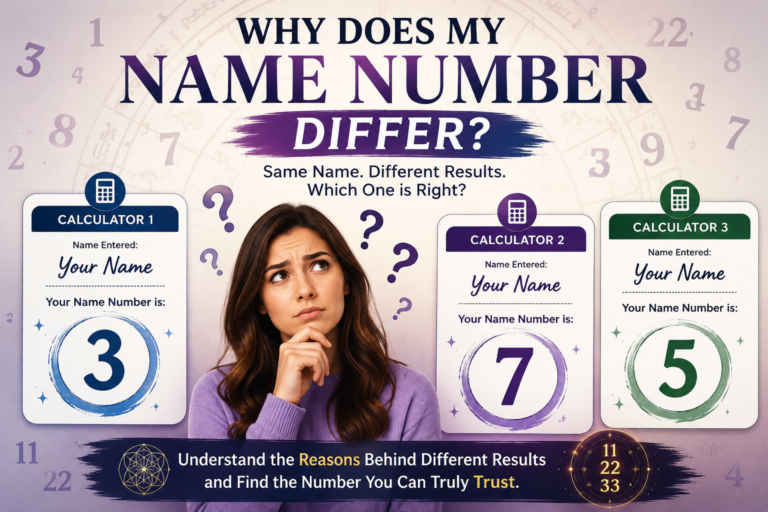
You don’t need to know where a system came from to use it. Plenty of people run their name through a calculator, get a number, read the meaning, and move on. That’s fine. But the history of name numerology is worth a few minutes because it explains something that confuses almost everyone who’s used more than one calculator: why do different sites give different results for the same name?
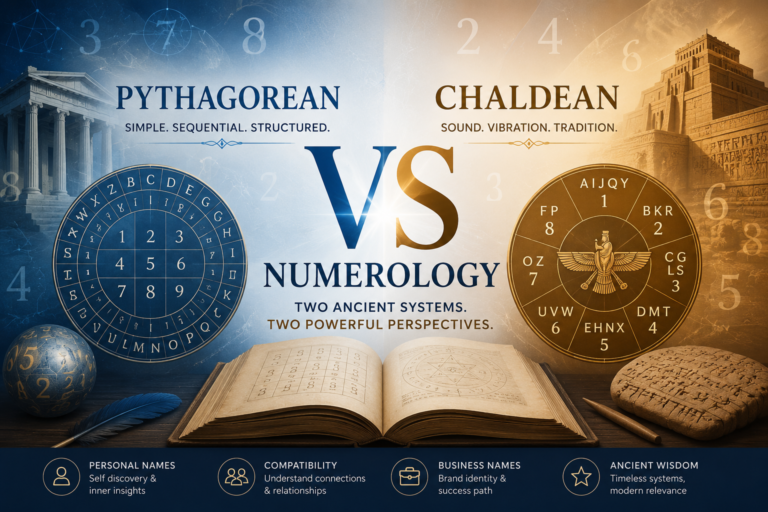
The answer sits in the past. Two of the biggest systems in use today, Pythagorean and Chaldean, were built centuries apart, in different parts of the world, for different reasons. Neither one was designed to agree with the other. Once you know that, the mismatch stops looking like an error and starts looking like exactly what it is — two separate traditions that happen to share a name.
Ancient Babylon and the Chaldean Roots of Numerology
Most historians trace the earliest structured number-symbolism back to ancient Babylon, home of the Chaldeans. This was a culture that had already merged mathematics and religion long before Pythagoras was born. Babylonian priests studied the movement of stars and planets, and they didn’t separate that study from the meaning of numbers. To them, counting wasn’t a neutral act — it was tied to the rhythm of the cosmos.
Chaldean numerology, the system many name numerology calculators still use, grew out of this worldview. Instead of assigning numbers to letters in strict alphabetical order, the Chaldeans grouped letters by the sound they made when spoken aloud. A letter’s number came from its vibration, not its position in the alphabet. This is why a Chaldean chart looks uneven at first glance, with several letters sharing the same digit and the number nine left out entirely, treated as too significant to assign to any single letter.
That single design choice — sound over sequence — is the reason Chaldean numerology still feels different from its Greek counterpart thousands of years later. It’s baked into the system’s DNA. Any honest account of the history of name numerology has to start here, because the Chaldean approach predates almost everything else on this list.
Pythagoras and the Greek Foundations of Numerology
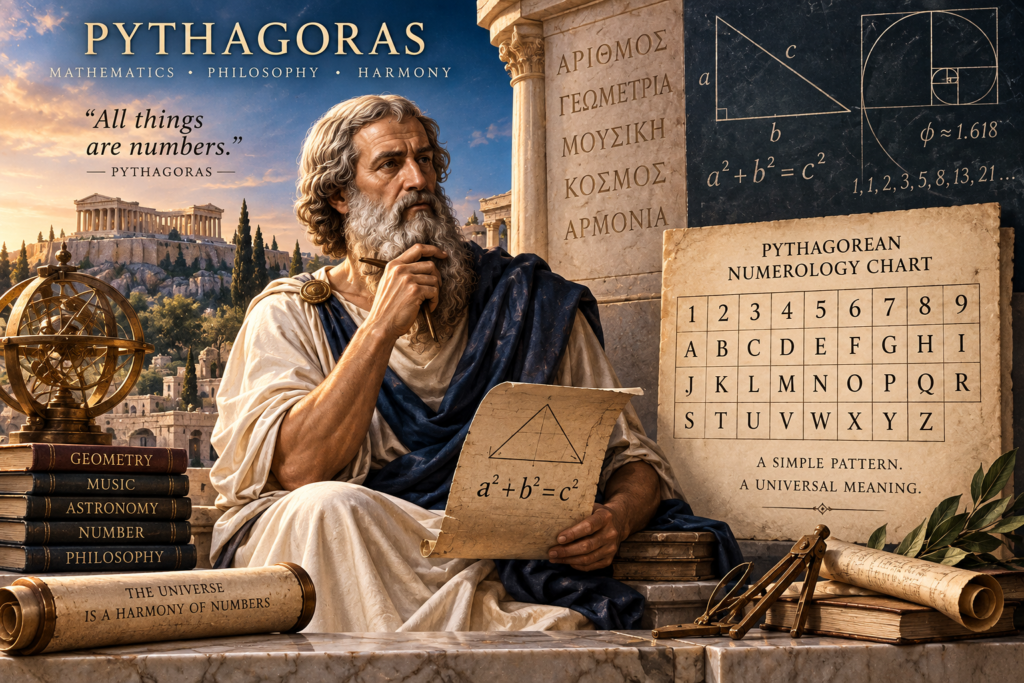
Move forward several centuries and the story shifts to ancient Greece, where the philosopher and mathematician Pythagoras built a framework that would eventually become the backbone of Western numerology. Pythagoras believed numbers weren’t just tools for counting — they were the underlying structure of reality itself. Music, geometry, the movement of planets, all of it reduced to numerical relationships in his view.
This belief led to a much simpler letter-numbering system than the Chaldean model. Pythagorean numerology assigns digits 1 through 9 in a repeating sequence straight across the alphabet: A is 1, B is 2, and so on, cycling back to 1 after I. There’s no grouping by sound, no missing numbers, no hidden logic to memorize. Just a clean, repeating pattern.
It’s worth mentioning that the direct link between Pythagoras and modern numerology is debated among historians. Some records suggest the specific “numbers as universal building blocks” framework often credited to him was actually formalized later, by a student named Philolaus, after the original Pythagorean school had already been destroyed. Regardless of who gets final credit, the system carries his name, and it remains the most widely used framework in Western practice today — including on most personal name calculators built for a Western audience.
A related Greek practice called isopsephy deserves a mention here too. Ancient Greeks used it to assign numeric values to words and names, sometimes for playful purposes (love notes carved with a lover’s “number” instead of their name have been found at archaeological sites like Pompeii) and sometimes for more serious symbolic readings. It’s a cousin to numerology rather than numerology itself, but it shows how deeply number-symbolism was woven into daily life in the ancient world.
Hebrew Gematria and the Spiritual Branch of Number Symbolism
While Greek and Babylonian systems were developing, a parallel tradition was forming within Jewish mysticism: Gematria. In Hebrew and several other ancient alphabets, letters doubled as numbers. This meant scripture couldn’t be read without also encountering its numerical structure — every word carried a hidden numeric value simply because of how the alphabet worked.
Gematria became closely tied to Kabbalah, the mystical branch of Jewish tradition, where numeric patterns in sacred texts were studied for deeper spiritual meaning. This is a different branch of the same tree as history of name numerology, but it shares a core assumption with both the Chaldean and Pythagorean systems: that letters and numbers aren’t arbitrary, and that a name or word carries information beyond its literal meaning.
This is also where a lot of the “biblical numerology” content you’ll find online today draws its roots from — the idea that specific numbers hold symbolic weight throughout religious texts. It’s a separate strand from name-based numerology, but the two are frequently discussed together because they share the same underlying belief system.
Vedic Numerology and the Indian Tradition

No account of this subject is complete without Vedic numerology, the tradition that developed in India alongside Vedic astrology. Vedic numerology takes a somewhat different approach than the Greek or Babylonian systems. It leans heavily on the relationship between a person’s name, their birth details, and planetary influences, treating numerology less as a standalone tool and more as an extension of astrology.
This tradition remains especially influential across South Asia today, and many modern numerology calculators built for Indian audiences default to systems rooted in this lineage rather than pure Pythagorean or Chaldean models. If you’ve ever noticed that some sites ask for both your name and your birth details before generating a full reading, that dual-input approach traces back to this Vedic influence.
The Middle Ages Through the Scientific Revolution: A Quiet Period
For a long stretch of history, numerology didn’t develop much as an independent practice — it lived inside astrology, religious study, and folk tradition rather than existing as its own field. The Scientific Revolution changed that relationship sharply. As mathematics separated itself from mysticism and became a formal discipline built on proof rather than belief, numerology was pushed to the margins. It didn’t disappear, but it stopped being treated as a serious intellectual pursuit and became something closer to folklore.
This period matters in the history of name numerology because it explains the gap between the ancient systems (Chaldean, Pythagorean, Gematria) and the modern packaged version most people encounter today. There wasn’t a clean, continuous line of development. There was a long quiet stretch where the practice survived mostly underground, passed through smaller communities rather than mainstream scholarship.
The 20th Century: Numerology Gets Its Name
Here’s a detail that surprises most people: the word “numerology” itself is relatively recent. Before the early 1900s, the practice was usually called the Science of Numbers or Arithmancy. Some records credit the modern term to a writer named Julia Seton, whose work in the 1930s helped popularize it under that label. Other sources point to Julian Strode as the one who coined it slightly earlier, giving an old practice a more structured, almost scientific-sounding name for a 20th-century audience.
Around the same period, a numerologist named L. Dow Balliett helped shape what would become the modern Life Path Number system — the birth-date-based calculation that sits alongside name numerology in most readings today. This is the point where numerology started to look like what we recognize now: structured charts, standardized calculations, and a defined set of numbers (1 through 9, plus master numbers) with agreed-upon meanings.
This modern packaging is a big part of why the history of name numerology can feel confusing. Someone reading a numerology chart today is engaging with a method that’s only about a century old in its current form, even though the underlying belief that letters and numbers carry meaning stretches back thousands of years further. Both things are true at once. The ideas are ancient. The specific chart format is not.
From Books to Software: The Digital Shift
For most of the 20th century, numerology lived in books, personal consultations, and hand-drawn charts. That changed with the internet. Once letter-to-number conversion could be automated, name numerology calculators became instant rather than something a person had to work out with pen and paper.
This shift did something interesting to the history of name numerology: it exposed inconsistencies that used to stay hidden. When a numerologist calculated a name by hand using one system, there was no easy way to compare it against someone else’s result using a different system. Now, anyone can run the same name through five different calculators in five minutes and see five different letter charts producing five different numbers. That’s not a flaw in the technology — it’s the same historical split between Chaldean, Pythagorean, and Vedic systems, just made visible in a way it never was before.
Understanding that history is genuinely useful here. It’s the difference between thinking a calculator is broken and understanding that it’s simply running one specific tradition out of several legitimate ones.
Master Numbers: A Later Addition Worth Knowing
One more piece worth including in any history of name numerology is the concept of master numbers — 11, 22, and 33 — which are treated differently from other numbers in most modern systems. Instead of reducing them down to a single digit the way every other total gets reduced, these three are left intact because they’re considered to carry amplified significance.
This isn’t part of the earliest Chaldean or Pythagorean frameworks in the form we recognize today. It’s a later addition that became standard as numerology was formalized in the 20th century, alongside the broader Life Path Number system. It’s now treated as a core feature of name and birth-date numerology alike, which is a good example of how the practice kept evolving well after its ancient origins.
How the Old Systems Actually Compare on Paper
It helps to see the differences side by side rather than just read about them in isolated paragraphs. Here’s a simple breakdown of the three major traditions covered so far:
| System | Origin | Core Logic | Number 9 Treatment |
|---|---|---|---|
| Chaldean | Ancient Babylon | Letters grouped by sound vibration | Excluded from the chart, considered sacred |
| Pythagorean | Ancient Greece | Letters assigned in repeating sequence (A=1, B=2…) | Included like any other digit |
| Vedic | Ancient India | Name linked to birth data and planetary rulership | Treated within a broader astrological framework |
Laid out this way, it’s easier to see why two calculators can take the same input and hand back two completely different outputs. They were never built to agree with each other in the first place. Each one reflects the intellectual priorities of the culture that produced it — Babylonian astronomy, Greek mathematics, or Indian astrology — and those priorities shaped the math itself, not just the interpretation layered on top of it.
This is also why comparing systems can be a genuinely useful exercise rather than a source of confusion, once you know what you’re looking at. Someone curious about their name can calculate it using more than one method and treat each result as a separate lens rather than expecting a single “correct” answer.
Regional Naming Conventions and Their Effect on Numerology
There’s a detail that rarely gets discussed but matters quite a bit in practice: naming conventions themselves have changed dramatically across the centuries and across cultures, and that shift affects how numerology gets applied. In much of the ancient world, names carried direct meaning — a Babylonian or Hebrew name often described a quality, a blessing, or a relationship to a deity. Numerology in that context wasn’t separating the “sound” of a name from its “meaning,” because the two were already tightly linked.
Modern naming, especially in Western countries, works differently. Names are often chosen for sound, family tradition, or personal taste, with far less attention paid to literal meaning. That shift changes what a numerology calculation is actually measuring. An ancient Chaldean priest calculating a name was working with a name that already carried intentional meaning. A modern calculator today is often working with a name chosen for entirely different reasons. Neither approach is wrong, but it’s a useful reminder that the practice has adapted alongside the culture around it, rather than staying frozen in its original form.
What the History of Name Numerology Tells Us About Using It Today
None of this history is meant to settle whether numerology “works” in any predictive sense. That’s a separate question, and a personal one. What the history of name numerology does offer is context — and context changes how you approach the numbers.
A few practical takeaways worth carrying forward:
- No single system is the “original” one. Chaldean numerology predates Pythagorean numerology by a significant margin, but neither one is more authentic than the other. They’re different traditions, not competing versions of the same truth.
- Consistency matters more than which system you pick. If you’re comparing your name number against someone else’s, or tracking it over time, staying within one system avoids the confusion that comes from mixing Chaldean and Pythagorean results.
- The modern chart format is younger than the ideas behind it. The specific 1-9 plus master number structure most calculators use today only took shape in the early 1900s, even though the belief that letters carry numeric meaning goes back to Babylon and Greece.
- Different regions favor different systems for cultural reasons, not accuracy reasons. Vedic numerology dominates in parts of South Asia for the same reason Pythagorean numerology dominates in the West — cultural transmission, not superior calculation.
Final Thoughts
The history of name numerology isn’t a straight line from one ancient genius to today’s calculator button. It’s closer to a river with several tributaries — Babylonian sound-based letter groupings, Pythagorean sequential mathematics, Hebrew Gematria, Vedic astrology-linked readings — all feeding into what eventually got packaged and named “numerology” in the 20th century. Each tradition brought its own logic, and traces of all of them still show up in the calculators people use today.
Knowing this history won’t change the number your name adds up to. But it does change how you hold that number — less as a fixed, universal fact, and more as the output of one specific, centuries-old tradition among several. That’s a more honest way to sit with the result, whichever system generated it.