
Numerology vs Astrology: What’s the Real Difference?
Ask someone to explain the difference between these two practices and most people pause, then land on something vague like “aren’t they basically the same thing?” It’s an understandable guess — both assign personal meaning to something a person didn’t choose, both produce a chart or number meant to say something about identity, and both get lumped together constantly in casual conversation. But Numerology vs Astrology is really a comparison between two structurally different systems, built on entirely different inputs, with only partial overlap in how they’re used. This guide breaks down exactly where they diverge and where the overlap genuinely exists.
The Core Distinction: What Each System Actually Measures
The clearest way to frame Numerology vs Astrology is by looking at the raw input each system works from. Astrology is built entirely around planetary positions — the specific location of the sun, moon, and other celestial bodies relative to the earth at the precise moment a person was born. That snapshot gets mapped onto a birth chart, divided into houses and signs, producing a detailed picture unique to that exact time and location.
Numerology works from something completely different: letters and digits. A person’s full name is converted into numeric values and reduced to an expression number, while their birth date is reduced separately into a life path number. There’s no reference to the sky at all — the entire system runs on arithmetic performed on names and dates, not on the position of any celestial body.
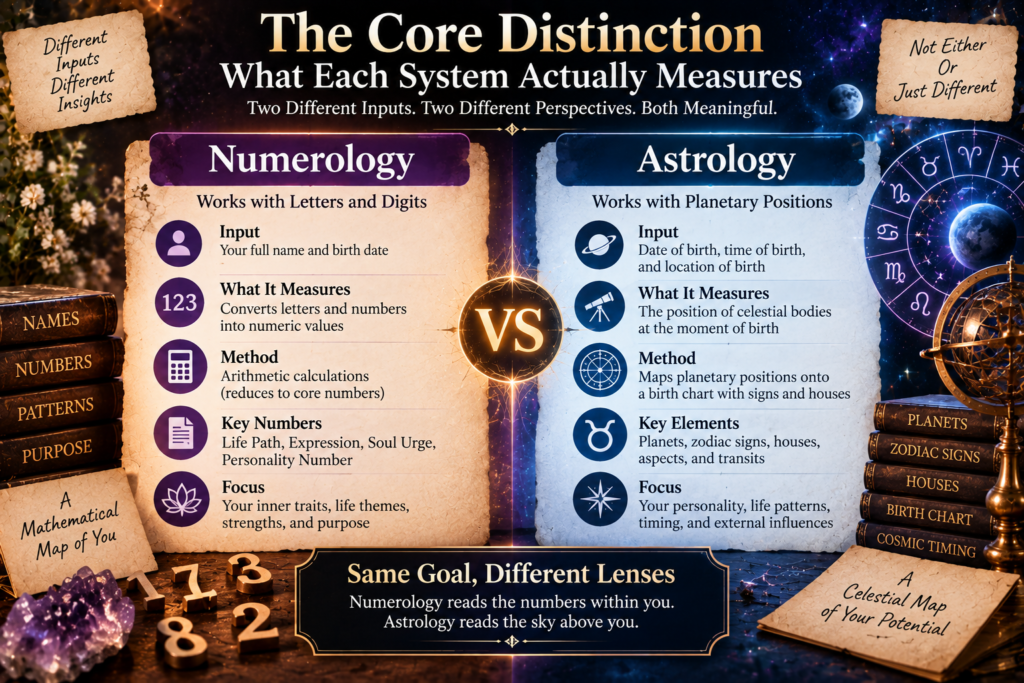
This is the foundational difference at the heart of any honest Numerology vs Astrology comparison: one system reads the sky, the other reads arithmetic. Everything else — how each practice is used, interpreted, and applied — builds on top of that basic split.
How the Calculations Actually Work
Astrology’s core calculation, a birth chart, requires three specific pieces of information: date of birth, time of birth, and location of birth. Even a small error in birth time can shift certain chart placements meaningfully, since the sky’s position relative to the earth changes continuously throughout the day. This level of precision is part of why full astrological readings are generally considered more involved than a basic zodiac sign, which only requires the birth date and reflects just one placement among many in a complete chart.
Numerology’s calculations are considerably simpler in mechanical terms. Under Pythagorean numerology, letters are assigned numbers 1 through 9 in a repeating alphabetical sequence, while Chaldean numerology groups letters according to phonetic sound rather than alphabet position. Either way, the calculation only needs a full name and a birth date — no time or location required — since neither factor plays any role in how letters or digits are converted into numbers.
This difference in required inputs is a practical distinction worth noting in any Numerology vs Astrology breakdown: numerology can be calculated from information almost anyone already knows off the top of their head, while a full astrological reading typically requires digging up a birth certificate or asking a parent for an exact birth time.
Historical Roots
Both practices carry long histories, though they developed along separate paths, which is a useful angle for anyone comparing Numerology vs Astrology from a historical perspective. Astrology’s roots trace back to ancient Mesopotamian and Babylonian sky-watching traditions, later refined by Greek astronomers and philosophers into the zodiac-based system still widely recognized today. Numerology’s roots run through a parallel but distinct lineage — Pythagorean numerology tracing to ancient Greek mathematical philosophy, and Chaldean numerology tracing back to the same broader Babylonian region that also shaped early astrology.
This shared regional origin is part of why the two practices are so often discussed together, even though they developed as separate systems rather than one branching directly out of the other. Vedic traditions across South Asia further developed both practices in parallel, often blending astrological and numerological readings within the same broader spiritual framework, which adds another layer to why the line between them can feel blurry in casual conversation today.
Where the Two Systems Genuinely Overlap
Despite the structural differences, Numerology vs Astrology isn’t a case of two completely unrelated systems. Several numerology traditions assign planetary rulership to specific numbers, drawing a direct symbolic link back to astrology. Number 1 is commonly associated with the Sun, number 2 with the Moon, and number 7 with Neptune, among other pairings that vary somewhat between numerology schools.
This overlap means a full numerology reading sometimes borrows language and symbolism directly from astrology, even while the underlying calculation method stays entirely separate. Some practitioners who work across both fields offer combined readings, cross-referencing a person’s zodiac sign against their life path number to look for reinforcing or contrasting themes, treating the two systems as complementary layers rather than competing alternatives.
Which One Is Considered More Detailed
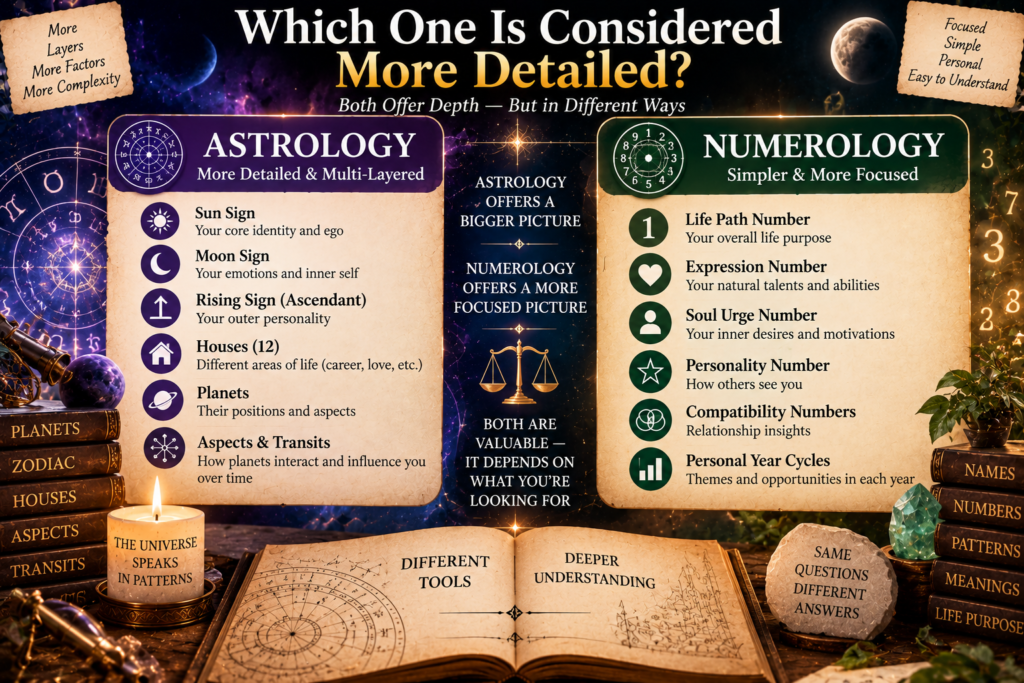
A full astrological birth chart typically produces a more layered, multi-part reading than a standard numerology profile — a detail worth flagging in any Numerology vs Astrology comparison focused on depth rather than accuracy. Beyond the commonly known sun sign, a complete chart includes a moon sign, rising sign, and placements across ten or more planetary bodies, each mapped into one of twelve houses — producing dozens of individual data points that a skilled astrologer weaves into a single cohesive reading.
A numerology profile, by comparison, typically centers on a smaller set of core numbers — the life path number, expression number, soul urge number, and personality number — each calculated independently and interpreted on its own. This isn’t necessarily a weakness; many people find numerology’s more compact structure easier to engage with directly, without needing a trained practitioner to interpret a complex, multi-layered chart.
Accuracy and Scientific Standing
Neither practice has demonstrated predictive accuracy under controlled scientific testing, and this is worth stating plainly rather than dancing around it. Both are generally classified as pseudoscience by the scientific community, since both make personality and outcome-related claims that haven’t held up when tested rigorously against measurable results. This is one area where Numerology vs Astrology doesn’t really produce a meaningful winner — the scientific criticism applies to both practices in largely the same way, for largely the same underlying reasons.
Where the two sometimes get compared unfavorably against each other is in popular perception rather than actual evidence. Astrology tends to receive more mainstream skepticism and more frequent scientific commentary simply because it’s more widely discussed and practiced, particularly through daily horoscope content, while numerology often escapes similarly intense scrutiny mostly because it receives less public attention overall, not because its underlying claims hold up any better under examination.
Practical Differences in How People Use Each One
Astrology tends to show up in daily or recurring content — horoscopes published regularly based on sun sign alone, offering broad, general guidance meant to be checked repeatedly over time. Numerology, by contrast, is more commonly treated as a one-time or occasional calculation — a life path number or expression number calculated once and revisited only when a specific decision, like a baby name or business name, prompts a fresh look.
This difference in typical usage pattern shapes how each practice tends to show up online. Astrology content is often structured around ongoing engagement, while numerology content is more frequently structured around single-use tools like calculators, reflecting the more static, one-time nature of the core calculation itself.
How Each System Handles Compatibility
Compatibility readings are one of the most popular applications of both practices, though each approaches the question differently — and it’s a helpful place to see Numerology vs Astrology play out in a practical, everyday context. Astrological compatibility typically compares two full birth charts, weighing sun sign, moon sign, and rising sign together, along with how various planetary placements interact between the two people involved. This produces a layered compatibility reading that accounts for emotional tendencies, communication style, and long-term compatibility across several dimensions at once.
Numerology compatibility, by contrast, generally compares a smaller set of numbers — most often life path numbers, sometimes paired with expression numbers — against an established compatibility chart specific to whichever numerology tradition is being followed. This produces a more compact reading, typically summarized as strong, moderate, or challenging compatibility between two specific numbers, without the same multi-layered complexity a full astrological comparison involves.
Neither approach to compatibility has been shown to reliably predict relationship outcomes under controlled testing, but both continue to be widely used as a starting point for reflection rather than a definitive verdict on whether a relationship will succeed.
Choosing Between the Two for Personal Reflection
For someone deciding which practice to explore first, the more practical distinction in the Numerology vs Astrology decision often comes down to accessibility and personal preference rather than any claim about accuracy. Numerology requires only a name and birth date, making it easy to calculate quickly without needing a trained practitioner, while a full astrological reading benefits considerably from professional interpretation, particularly once a chart includes multiple house and planetary placements that aren’t always straightforward to read without guidance.
Some people find the sky-based symbolism of astrology more intuitive and easier to relate to personally, while others prefer numerology’s more compact, number-based structure. There’s no requirement to pick one over the other permanently — plenty of people move between both depending on the specific question they’re trying to reflect on, whether that’s a broad personality overview, a relationship compatibility check, or a decision like naming a business or a child.
Frequently Asked Questions
Is numerology considered a branch of astrology?
No. While the two share some symbolic overlap, particularly around planetary associations with certain numbers, they developed as separate systems with entirely different calculation methods, not as one practice branching directly out of the other.
Which is more accurate, numerology or astrology?
Neither has demonstrated predictive accuracy under controlled scientific conditions. Both are generally classified as pseudoscience by mainstream science, so in the Numerology vs Astrology accuracy debate specifically, neither system comes out objectively ahead of the other.
Can I use numerology and astrology together?
Yes, and many practitioners do exactly this, treating a zodiac sign and a life path number as complementary lenses rather than competing systems, particularly given the planetary associations some numerology traditions already draw with specific numbers.
Which practice came first historically?
Both trace back to overlapping ancient regions, particularly Babylon, making it difficult to definitively say one predates the other. They’re generally considered to have developed alongside each other rather than one clearly preceding the other.
Do astrology and numerology ever contradict each other in a reading?
They can, simply because they’re built from entirely different inputs and calculation methods. A contradiction between a zodiac-based reading and a numerology-based reading isn’t treated as evidence that one system is wrong, but rather as a reminder that each offers a separate, independent lens rather than a single unified prediction.
Final Thought
Numerology vs Astrology ultimately comes down to two systems built on fundamentally different foundations — one reading planetary positions at the exact moment of birth, the other performing arithmetic on names and dates. They share some symbolic overlap and a loosely connected regional history, but they remain distinct practices with their own calculation methods, their own traditions, and their own ways of being used day to day. Neither has scientific backing for predictive accuracy, but both continue to offer millions of people a structured way to reflect on identity, timing, and meaning.