
Common Misconceptions About Numerology: 9 Myths Explained
Numerology has fascinated people for generations because it offers a symbolic way to explore numbers, personality, and life experiences. From Life Path Numbers to name numerology, many people use these interpretations as tools for curiosity, self-reflection, or spiritual exploration. However, misunderstandings can develop when traditional beliefs are treated as proven facts or when numerical patterns are assumed to predict every aspect of life.
Understanding the common misconceptions about numerology can help you explore this subject with a more balanced perspective. Some people believe that numbers reveal a person’s destiny, determine relationship compatibility, or explain why certain events happen. Others dismiss numerology entirely without understanding how its traditional systems work.
This guide examines nine widespread myths about numerology, explains what different numerology traditions actually suggest, and highlights the difference between symbolic interpretations and scientific evidence. Whether you are new to numerology or already familiar with its core numbers, these explanations can help you approach the subject more thoughtfully.
What Is Numerology, and Why Do People Misunderstand It?
Numerology is a collection of traditional systems that assign symbolic meanings to numbers. Different approaches use numbers from birth dates, names, and other numerical patterns to develop interpretations about personality, relationships, or life themes.
For example, a common modern numerology method calculates a Life Path Number from a person’s birth date. Another method converts letters in a name into numbers to calculate an Expression Number. Practitioners then interpret the results according to the rules of their particular system.
The difficulty begins when these interpretations are presented as universal truths. Numerology traditions differ in their calculations and meanings, and scientific research has not established that numerology can reliably predict personality or future events.
Understanding this distinction makes it easier to appreciate numerology as a cultural or spiritual practice without assuming that every claim associated with it is accurate.
9 Common Misconceptions About Numerology
The following myths explain some of the most frequent misunderstandings surrounding numerology and offer a more balanced way to think about each one.

Myth 1: Numerology Can Predict Everything About Your Future
One of the most common misunderstandings is that numerology can reveal exactly what will happen in someone’s future. Some interpretations associate particular numbers with opportunities, challenges, or periods of personal growth, which may lead people to expect specific outcomes.
However, a numerology calculation cannot reliably establish when someone will get married, become wealthy, change careers, or experience a major life event.
A person’s future depends on many factors, including personal decisions, circumstances, relationships, opportunities, and events outside their control. A number cannot account for all these variables.
A more balanced perspective: Use numerology interpretations as optional prompts for reflection rather than fixed predictions. If a reading encourages you to think about your goals, consider how you can take practical steps toward them.
Myth 2: Your Life Path Number Defines Your Entire Personality
The Life Path Number is one of the best-known concepts in modern numerology. It is usually calculated from a person’s full birth date and interpreted as representing broad themes or tendencies.
Some descriptions associate Life Path Number 1 with independence, Number 2 with cooperation, and Number 7 with introspection. These are traditional symbolic associations, not scientifically validated personality categories.
Two people with the same Life Path Number can have very different interests, values, strengths, and life experiences. Their personalities are shaped by many influences that cannot be captured by a single number.
A more balanced perspective: Explore Life Path Number meanings as a starting point for self-reflection. Compare the interpretation with your real experiences instead of assuming that every description must fit you.
Myth 3: Numerology Is the Same as Astrology
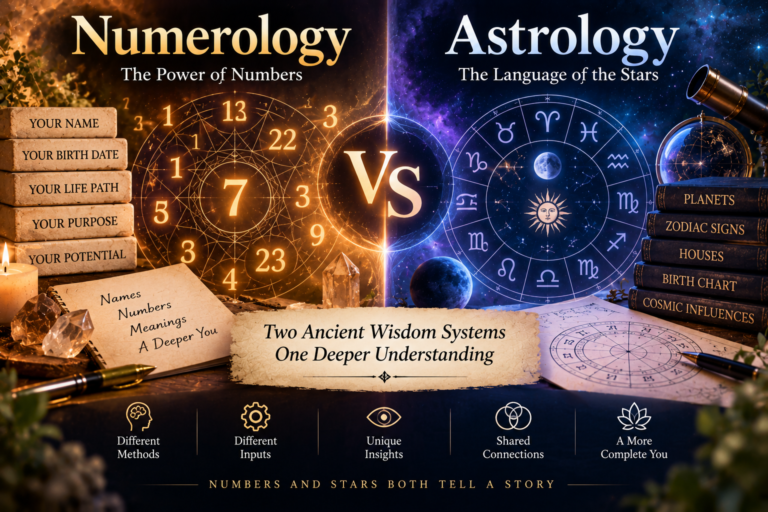
Numerology and astrology are sometimes grouped together because both have spiritual and symbolic traditions. However, they use different methods.
Numerology generally focuses on numbers derived from birth dates, names, and numerical patterns. Astrology interprets the positions and movements of celestial bodies in relation to a person’s birth chart or other astrological framework.
For example, a numerologist may calculate a Life Path Number using a birth date, while an astrologer may examine planetary placements, zodiac signs, and houses.
Although some people combine these practices, they are not interchangeable systems. Their terminology, calculations, and interpretive methods differ.
A more balanced perspective: Learn the basic principles of each practice separately before comparing them. This makes it easier to understand what a particular interpretation actually represents.
Myth 4: Certain Numbers Are Always Lucky or Unlucky
Another common misconception is that a number must always bring good or bad luck. Number 7, for example, is associated with good fortune in several cultural contexts, while Number 13 is considered unlucky in some traditions. Yet these associations are not universal.
A number can have different meanings depending on cultural background, religion, historical context, and numerology tradition. Even within a single tradition, its interpretation may depend on where it appears in a calculation.
The idea that a number is inherently lucky or unlucky is therefore better understood as a cultural or symbolic belief than as an established fact.
A more balanced perspective: Consider the cultural context behind a number’s reputation. Avoid making important decisions solely because you believe a particular number will bring good or bad luck.
Myth 5: Numerology and Scientific Evidence Are the Same Thing
Numerology uses calculations and numerical patterns, but this does not automatically make its interpretations scientific.
Mathematics can verify that a calculation is correct. For example, adding the digits of a birth date can produce a consistent numerical result when a defined method is followed. However, the symbolic meaning assigned to that result is a separate claim.
Scientific claims require appropriate evidence, clearly defined methods, and results that can be tested and independently evaluated. Numerology has not been established as a reliable scientific method for predicting personality, compatibility, or future events.
This distinction does not prevent people from finding personal or cultural meaning in numerology. It simply clarifies the limits of what the practice can demonstrate.
A more balanced perspective: Separate the accuracy of the arithmetic from the validity of the interpretation. A calculation can be mathematically correct even when the meaning attached to it has not been scientifically demonstrated.
Myth 6: Everyone With the Same Number Has the Same Destiny
Some numerology descriptions present people with the same core number as having similar life themes. It is easy to misunderstand these descriptions as meaning that everyone with that number will experience the same events.
In reality, people who share a birth date pattern or Life Path Number may live very different lives. Their circumstances, education, opportunities, relationships, and personal choices are not identical.
For example, two people with Life Path Number 3 might both encounter a traditional interpretation involving creativity or communication. One might express these themes through writing, while another might enjoy teaching, music, or public speaking. Neither outcome is guaranteed by the number.
A more balanced perspective: Treat numerical interpretations as broad symbolic themes rather than detailed descriptions of an individual’s destiny.
Myth 7: You Must Change Your Name to Improve Your Numerology
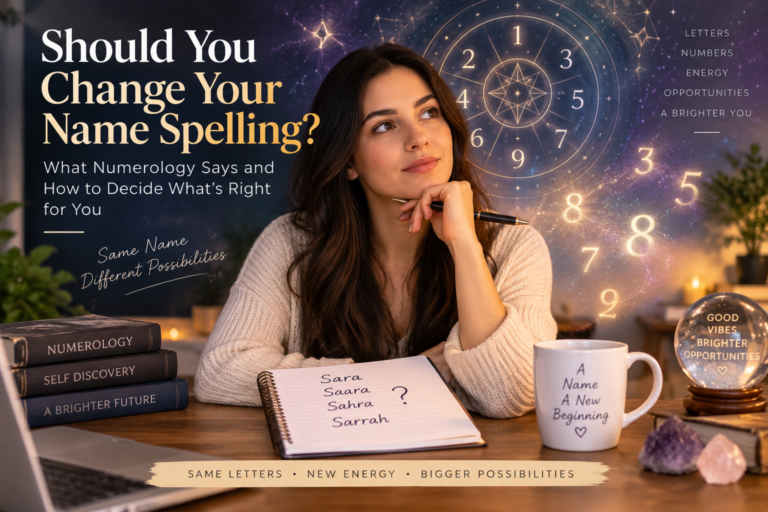
Name numerology assigns numerical values to letters and interprets the resulting totals. Some practitioners believe that a name’s numerical pattern carries symbolic significance.
This has led to the idea that changing a name or spelling can automatically improve someone’s luck, career, relationships, or financial circumstances. However, there is no reliable scientific evidence that changing a name to achieve a preferred numerology number guarantees these outcomes.
A name change can have personal, cultural, professional, or emotional significance, but it should be considered carefully for reasons beyond a numerical calculation.
A more balanced perspective: If you enjoy name numerology, use it as an interesting interpretive exercise. Do not feel pressured to change your legal name, professional identity, or personal documents because of a numerology reading.
Myth 8: A Difficult Numerology Reading Means Something Bad Will Happen
Some numerology interpretations associate certain numbers with challenges, responsibility, or lessons. Karmic Debt Numbers 13, 14, 16, and 19 are examples commonly discussed in particular numerology traditions.
The problem occurs when these interpretations are presented as warnings that a person is destined to suffer, lose relationships, experience financial problems, or face unavoidable hardship.
A numerology reading cannot establish that a specific negative event will occur. Difficult experiences have many possible causes, and a numerical result is not reliable evidence of what lies ahead.
Traditional descriptions of challenging numbers can also be interpreted constructively. For example, 13/4 is often associated with discipline, while 14/5 is linked with balance and responsible freedom.
A more balanced perspective: If a reading feels negative, focus on whether it raises a useful question about your habits or decisions. Do not treat it as a prediction or a reason to fear the future.
Myth 9: Numerology Can Replace Practical Decision-Making
Numerology can be interesting to explore, but relying on it as the sole basis for major decisions is a misunderstanding of its limitations.
Choosing a career, making a financial commitment, evaluating a relationship, or considering a health concern requires information relevant to the actual situation. A numerical interpretation cannot replace professional advice, evidence, personal communication, or careful planning.
For example, a person considering a job offer should examine salary, responsibilities, working conditions, career prospects, and personal goals. A Life Path Number should not determine whether the offer is accepted or rejected.
Similarly, relationship decisions are better informed by communication, mutual respect, compatibility in real-life values, and each person’s behavior than by numerical compatibility alone.
A more balanced perspective: Use numerology, if you wish, as one optional way to reflect on your preferences. Base important decisions on relevant evidence, practical considerations, and your own judgment.
Four More Myths Worth Knowing
The nine myths above cover the most frequent misunderstandings, but four further points are worth adding, because they explain why results can differ between calculators and readings.
Letter Values Differ by System
A name does not have one fixed number. Pythagorean numerology follows a simple repeating one-to-nine alphabetical sequence, while Chaldean numerology groups letters by phonetic sound, so the same name can produce two different Expression Numbers. Neither result is more correct than the other; each follows different rules.
A more balanced perspective: Note which system a calculator or reading uses before comparing results. A disagreement between two tools is often a different system, not a broken calculation.
The Number 13 Is Not Always Unlucky
The fear of 13 is largely a separate cultural and religious tradition, rather than a rule from numerology itself. In most structured systems, 13 reduces to 4 (1 + 3 = 4), a number traditionally linked with stability, structure and discipline. Some traditions do describe 13 as a karmic debt number, carrying a lesson to address, but that is a narrow interpretation, not a universal verdict that the number is cursed.
A more balanced perspective: Treat 13 as a compound number with its own context, rather than as a simple sign of bad luck.
Master Numbers Are Not a Guarantee of Exceptional Destiny
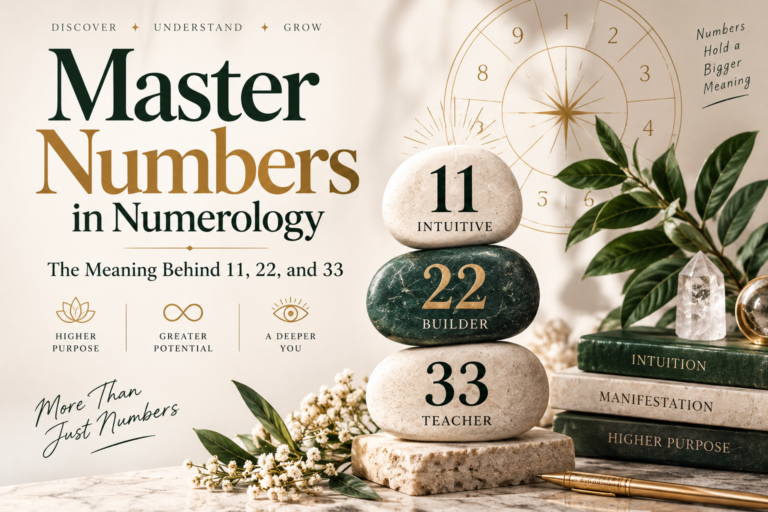
Master numbers – 11, 22 and 33 – are left unreduced, which has encouraged the idea that they guarantee an unusually significant or successful life. Most traditional sources describe them as carrying heightened potential alongside heightened difficulty: 11 is linked with intense intuition and internal tension, while 22 is linked with large-scale ambition and a heavy practical burden to deliver on it.
A more balanced perspective: Read a master number as added complexity, not as a promise of success.
Calculator Reduction Rules Can Differ
Even calculators using the same letter system can give different answers, because they do not all handle reduction in the same way. Some reduce every total straight to a single digit without checking for a master number on the way, silently skipping 11, 22 or 33 when one appears as an intermediate number rather than only in the final result. Others recognise master numbers inconsistently, catching them at the end but missing them earlier in the calculation.
A more balanced perspective: When results differ, check both the letter system and whether master numbers are recognised throughout the calculation, not only at the final step.
Numerology Systems: A Quick Comparison
Many myths come from treating numerology as one uniform method. In practice, the main systems use different rules, which is why the same name or birth date can give different results.
Pythagorean Numerology – the most widely used system in Western countries, assigning letter values on a simple one-to-nine grid.
Chaldean Numerology – an older system from ancient Babylon, using a different letter-to-number assignment and placing emphasis on vibration and sound.
Kabbalah Numerology – rooted in Jewish mysticism, focusing on the Hebrew alphabet and layered spiritual symbolism.
Vedic Numerology – originating in India, drawing direct connections between numerology and astrology, particularly planetary influences.
Someone who gets one number from a Pythagorean calculation and a different number from a Chaldean calculation has not necessarily found an error; they have compared two distinct traditions.
Numerology Compatibility: Another Layer of Confusion
Compatibility is one of the most searched numerology topics, and it carries its own misunderstandings. Many people assume that if two Life Path Numbers do not match on a chart found online, the relationship is doomed. In practice, compatibility readings look at how two number profiles might interact, highlighting possible friction points and natural strengths rather than issuing a pass-or-fail verdict.
Charts also vary between practitioners and schools. A pairing described as challenging in one tradition might be described as complementary in another. A more balanced approach treats a compatibility reading as a conversation starter about communication styles and values, not as a binding verdict on whether two people belong together.
Numerology in Pop Culture and Social Media
Short videos about angel numbers such as 111 or 1111 often present numerology as a constant stream of mystical signs to decode, stripped of the calculation-based framework that traditionally defines the practice. This has blended numerology with general spiritual signs, synchronicities and manifestation culture until the lines between them blur.
Angel numbers are a narrow, modern offshoot rather than the full discipline. Viewers who only meet numerology through this lens often miss the calculation methods, historical systems and personality frameworks that make up traditional practice. Longer explanations, historical context and more than one system give a fuller picture than short clips alone.
How to Spot a Numerology Myth Before Believing It
A few quick checks help separate accurate information from exaggerated claims. First, check whether a source names the system – Pythagorean or Chaldean – it is drawing from; a resource that blends both without saying so is often working from secondhand summaries. Second, treat claims involving guaranteed outcomes, exact dates or absolute compatibility verdicts with extra care, since traditional practice usually frames readings in terms of tendencies and themes. Finally, cross-reference a surprising claim against more than one established resource, rather than accepting a single site’s explanation at face value.
Why These Misconceptions Matter
Persistent misunderstandings can shape real decisions, from how people approach relationships and careers to how much money they spend on readings, courses or personalised reports. Someone convinced that numerology guarantees a specific future might make a major decision on incomplete or exaggerated information rather than genuine reflection.
Dismissing numerology entirely as baseless superstition also misses its long-standing cultural and psychological role. Many people use it in a similar way to journaling or meditation, as a structured way to reflect on personal patterns and life transitions. Correcting these misconceptions does not mean discrediting the practice; it means giving people accurate context so they can decide, with clear eyes, how much weight to give it in their own lives.
Why Do People Believe Numerology Myths?
Understanding why misconceptions spread can help readers evaluate numerology claims more carefully. Several common psychological and social factors may contribute.
The Desire to Find Meaning in Patterns
People naturally look for patterns in everyday life. Repeated numbers on clocks, dates, addresses, or receipts can attract attention, especially when the numbers already have personal or cultural significance.
Noticing a pattern can feel meaningful, but noticing it does not establish that the pattern predicts an event or carries a message from an external source.
Confirmation Bias
Confirmation bias is the tendency to pay more attention to information that supports an existing belief while overlooking information that challenges it.
For example, someone who believes Number 7 brings good luck may remember the successful events associated with that number more easily than unrelated disappointments. This can strengthen the belief even when the overall evidence is unclear.
Recognizing confirmation bias can encourage a more balanced approach to numerology interpretations.
Broad Descriptions That Feel Personal
Some numerology readings use descriptions that apply to many people, such as being independent at times but also valuing support from others. Readers may recognize parts of themselves in these statements and feel that the reading is uniquely accurate.
This does not mean every personal interpretation is meaningless. It does mean that a description feeling accurate is not, by itself, proof that the numerical system can reliably assess personality.
Cultural and Family Traditions
Beliefs about numbers are passed down through families, communities, religions, and popular culture. These associations can become meaningful parts of a person’s worldview.
Learning about the history and cultural context of a belief can help explain why it matters to people without requiring everyone to accept the same interpretation.
How to Explore Numerology Without Misunderstanding It
You do not have to reject numerology completely to approach it critically. The following practices can help you explore its traditional meanings while maintaining a realistic perspective.
Understand the Calculation Method
Different numerology systems may use different rules. Before interpreting a number, check how it was calculated and whether the method preserves certain numbers, such as master numbers or karmic debt numbers, rather than reducing every result in the same way.
Knowing the method helps you understand what a reading actually claims.
Ask Questions Instead of Accepting Every Claim
If an interpretation says that a number represents independence, consider whether that idea reflects your own experiences. Ask what supports the interpretation and whether another explanation might fit just as well.
This approach makes numerology a reflective exercise rather than a set of instructions that must be followed.
Avoid Fear-Based Predictions
Be cautious of readings that claim you are cursed, destined to fail, or required to pay for a supposed past-life debt. A numerology calculation cannot verify such claims.
No one should pressure you into spending money, changing important life plans, or making major personal decisions by creating fear around your numbers.
Keep Practical Evidence in the Picture
Personal reflection can be valuable, but real-world evidence remains important. When making decisions about work, money, relationships, or health, consider the facts and seek appropriate professional guidance when needed.
Respect Different Beliefs
People approach numerology in different ways. Some see it as a spiritual practice, others as a cultural tradition, and others as entertainment or a self-reflection tool.
A thoughtful discussion can recognize these differences while remaining clear about what has and has not been scientifically established.
Frequently Asked Questions About Numerology Misconceptions
1. What are the most common misconceptions about numerology?
Common misconceptions include believing that numerology predicts every future event, that a Life Path Number defines an entire personality, and that certain numbers always bring good or bad luck. Other myths suggest that numerology is scientifically proven or should determine major life decisions.
2. Is numerology scientifically proven?
Numerology has not been established as a scientifically reliable method for predicting personality or future events. Its calculations can be mathematically correct, but the symbolic meanings assigned to numbers are separate interpretations that require independent evidence.
3. Can numerology predict my future accurately?
There is no reliable scientific evidence that numerology can consistently predict specific personal events. Some people find its interpretations meaningful for reflection, but they should not be treated as guaranteed predictions.
4. Are some numbers really unlucky in numerology?
Some numbers are considered unlucky in particular cultural or spiritual traditions, while other traditions interpret them differently. These associations are symbolic beliefs rather than established evidence that a number causes good or bad outcomes.
5. Should I use numerology to make important life decisions?
Numerology can be used as an optional reflection tool, but it should not replace practical evidence or independent judgment. Career, financial, relationship, and health decisions should be based on relevant information and appropriate professional advice when needed.
Final Thoughts: Understanding Numerology With a Balanced Perspective
Learning about the common misconceptions about numerology helps you distinguish traditional symbolic interpretations from claims that go beyond the available evidence. Numbers can have cultural, historical, spiritual, and personal significance, but their meanings are not universal, and numerical calculations cannot guarantee a particular personality or future.
Whether you explore Life Path Numbers, name numerology, or karmic debt numbers, approach each interpretation with curiosity rather than fear. Consider what resonates with your experiences, question claims that promise certainty, and remember that your decisions are influenced by far more than a numerical result.
The most useful approach is to remain open to learning while thinking critically. You can appreciate numerology as a traditional or personal practice without allowing it to replace practical judgment, reliable information, or your own ability to shape your life.