

Should You Change Your Name Spelling? A Numerology Guide
Somewhere between a numerology reading and a decision to actually act on it sits a question a lot of people quietly sit with for months: should you change your name spelling because a numerologist told you your current one isn’t working in your favor? It sounds like a small edit on paper — one added letter, one swapped vowel but the decision touches identification documents, how a name looks on a resume, and sometimes a person’s entire relationship with something as personal as their own name. This guide walks through what actually happens numerologically when you change your name spelling, who tends to do it, what the alternatives are, and how to think through the decision without treating a numerologist’s suggestion as an automatic requirement.
What Actually Shifts When You Change Your Name Spelling
Every letter in a name contributes a value to its overall calculation, so even a single-letter adjustment can shift the resulting number. This is the entire premise behind spelling-based numerology corrections — the letters are the raw input, and the expression number (sometimes called the destiny number) is the output built from adding those letter values together and reducing the total.
Take a name like “Karan.” Using a Pythagorean letter-to-number chart, K=2, A=1, R=9, A=1, N=5, adding up to 18, which reduces to 9. Add a single letter, making it “Karann,” and the total shifts to 18 + 5 = 23, which reduces to 5 — a completely different result from just one repeated letter at the end. This is the mechanic at the heart of every decision to change your name spelling for numerology purposes: small edits produce real, calculable shifts in the final number, even when the name is still pronounced almost identically.
It’s worth being clear about what doesn’t shift. A person’s life path number, calculated from their date of birth rather than their name, stays exactly the same no matter how the name is spelled. Spelling adjustments only affect name-based numbers — the expression number, and by extension any compound number calculated along the way — not the birth-date-based numbers that numerology treats as fixed for life.
Why People Consider This in the First Place
Most people who decide to change your name spelling for numerology reasons fall into a handful of recurring situations.
A numerology reading flagged a mismatch. Someone consults a numerologist, learns their name’s expression number sits in tension with their life path number under a given compatibility framework, and is told a specific spelling adjustment could bring the two numbers into better alignment.
A career or business setback prompts a search for explanations. After a period of professional struggle, some people look at every available lever, including numerology, and a practitioner suggests that a name correction might remove a perceived obstacle tied to the name’s current number.
A public figure or performer wants a name suited to visibility. Actors, musicians, and public-facing entrepreneurs sometimes adopt a professional name distinct from their legal one, and numerology is one of several factors — alongside memorability and branding — that goes into choosing the spelling of that public name.
Cultural or family naming traditions intersect with numerology practice. In some communities, particularly where Chaldean numerology and Vedic-influenced naming customs are well established, checking and adjusting a child’s name spelling shortly after birth, based on the birth chart, is a fairly common practice rather than an unusual one.
Step 1: Confirm What’s Actually Being Measured
Before deciding whether to change your name spelling, it’s worth confirming exactly which number a numerologist or calculator flagged as unfavorable. “Name number” is used loosely, but it usually refers to one of several distinct calculations: the expression number, built from every letter in the full name; the soul urge number, built from vowels only; or the personality number, built from consonants only. A spelling adjustment aimed at shifting one of these can leave the others untouched, so it helps to know precisely which number the recommendation is actually targeting before making any changes.
Step 2: Choose Which Numerology System You’re Working From
Chaldean numerology and Pythagorean numerology assign different values to several letters, which means a spelling change that improves a name’s number under one system might do nothing — or even work against it — under the other. Before you change your name spelling, confirm which system the original reading was based on, and stick to that same system when testing potential new spellings. Mixing values from both traditions partway through produces a result that doesn’t reliably belong to either one.
Step 3: Test Several Spelling Variants Before Committing to One
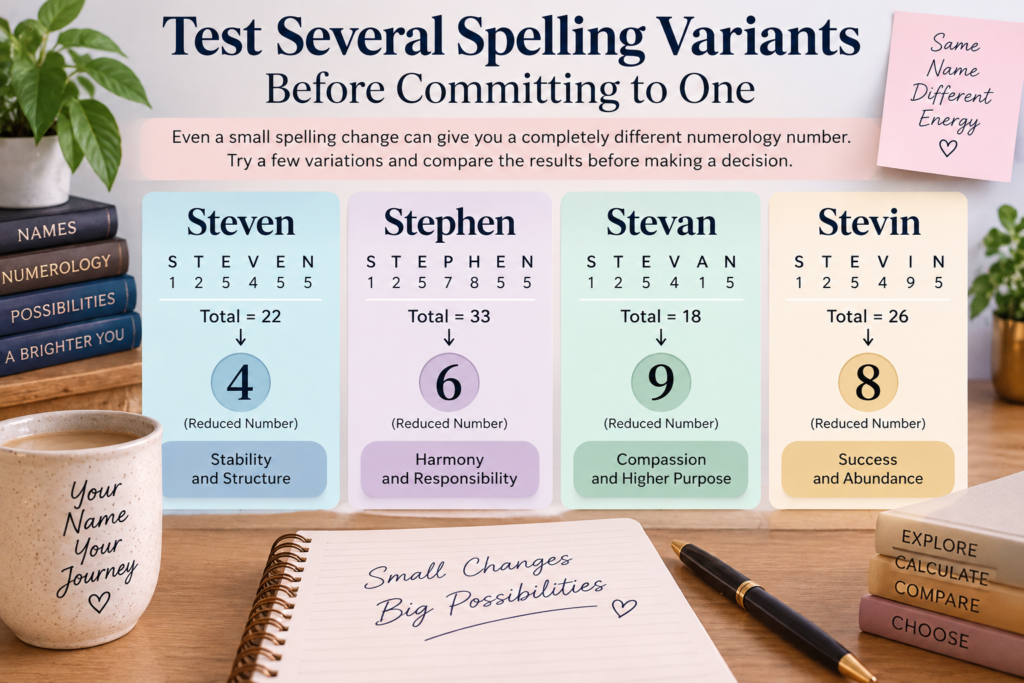
Rather than jumping straight to the first suggested adjustment, it’s worth calculating a handful of spelling variants side by side. Someone named “Steven,” for instance, might test “Stephen,” “Stevan,” or “Stevin” — each producing a different expression number, and each still recognizably the same name when spoken aloud. Laying out three or four options next to their calculated numbers, including the compound number each one passes through before final reduction, makes it much easier to choose a version that genuinely improves the reading rather than settling for the first option presented.
Step 4: Decide Between a Legal Change and a Practical Workaround
This is often the most overlooked step in the entire process. A full legal name change — updating identification, bank records, and official documents — is a significant undertaking, and it’s not the only way to apply a numerology correction.
Signature numerology is the practical alternative many people choose instead. Rather than legally altering the name on record, a person adjusts how they sign documents, write their name on business cards, or present it professionally — inserting a middle initial, adjusting capitalization, or adding a small stylistic element to the signature itself. Because a signature is treated as a name’s active, everyday expression in some numerology traditions, adjusting it is believed by practitioners to shift a meaningful portion of the name’s numerological influence without the legal complexity of a full Change Your Name Spelling.
Some people take a middle path: keeping their legal name unchanged on official documents while using an adjusted spelling professionally, on a business card, an author byline, or a stage name. Before you fully change your name spelling on every legal document, it’s worth considering whether a signature-level or professional-use adjustment achieves the intended shift with far less administrative disruption.
Step 5: Weigh the Practical Costs of a Full Legal Change
If a full legal change is genuinely what you want, it helps to go in with a clear picture of what’s involved. Depending on where you live, this typically includes a court filing or government application, updated identification documents, bank and financial account updates, and notifying employers, schools, or licensing bodies tied to your name. None of this is impossible, but it takes real time and, in many places, a modest filing fee.
People who go through with the full legal route generally report that the numerology motivation works best paired with at least one other genuine reason for wanting the change — simplifying a difficult-to-pronounce spelling, aligning with a cultural naming preference, or matching a name already used informally by friends and family. A purely numerology-driven legal change, undertaken with no other underlying reason, is a bigger commitment than most people initially expect once the paperwork begins.
Step 6: Recalculate and Compare Against Your Life Path Number
Once you’ve settled on a specific spelling adjustment, whether legal or signature-based, recalculate the new expression number and compare it against your life path number the same way you would when evaluating any name. This closes the loop on the original reading that prompted the consideration in the first place, confirming whether the new spelling actually produces the intended shift rather than assuming it does based on the adjustment alone.
If you’d rather run several spelling variants side by side without doing the arithmetic by hand each time, a Name Numerology Calculator can calculate the expression number for each version in seconds, which is especially useful during Step 3 when comparing multiple candidate spellings at once.
How Cultures Around the World Approach Name Correction Differently

Naming correction practices vary quite a bit depending on where and how they developed. In parts of South Asia, particularly among communities where Chaldean numerology and Vedic astrology overlap, checking a name against a child’s birth chart shortly after birth is fairly routine, and adjusting the spelling if the numbers don’t align is treated as a normal part of early parenting rather than an unusual intervention. In these traditions, a name correction later in life — say, in a person’s twenties or thirties — is also fairly common if a family consults a numerologist during a difficult period and receives a spelling recommendation as part of the reading.
In Western numerology practice, name correction tends to be a more individual, less family-driven decision. It’s more commonly associated with entertainers adopting stage names, entrepreneurs rebranding personally alongside a business, or individuals going through a broader period of self-reinvention where a Change Your Name Spelling is one part of a larger set of life changes rather than a numerology-only decision.
Neither approach is inherently more valid than the other — they reflect different cultural relationships with the idea that a name is something that can, and sometimes should, be actively managed rather than treated as fixed from birth.
What a Numerologist Actually Does During a Name Correction Consultation
For readers considering a professional consultation before making any spelling adjustment, it helps to know what the process typically involves. A numerologist usually starts by calculating the existing name’s expression number, soul urge number, and personality number, then compares each against the life path number derived from the birth date. From there, they typically identify which specific number appears to be creating friction — a mismatch, a missing element, or an absence of numbers considered favorable for the person’s stated goals, whether that’s career growth, relationship stability, or general wellbeing.
Once the friction point is identified, the numerologist usually proposes one or more spelling adjustments, often showing the client several options rather than a single fixed suggestion, since different adjustments can shift different numbers by different amounts. A thorough consultation should walk through exactly which number each proposed spelling change is meant to affect, rather than simply presenting a new spelling without explaining the reasoning. If a numerologist can’t explain which specific calculation a suggested change addresses, it’s worth asking directly before committing to anything, legal or otherwise.
Step 8: Give the New Spelling Time Before Judging the Results
A spelling adjustment doesn’t produce an overnight shift in how life unfolds, and most numerologists caution against expecting one. It typically takes months, sometimes longer, for a person to fully transition after they change your name spelling and start using it consistently across daily life — introducing themselves differently, updating email signatures, correcting people who default to the old spelling out of habit. Judging whether a change actually helped within the first few weeks tends to conflate the adjustment period itself with the numerological effect it was meant to produce, so most practitioners recommend giving a new spelling at least six months to a year of consistent use before drawing any conclusions.
What Numerologists Generally Say About Master Numbers in This Context
One detail worth watching for during any spelling adjustment is the accidental creation, or accidental loss, of a master number. If an original name’s calculation totals 22 before reduction, and a spelling adjustment shifts that total to 21 or 23, a master number that was previously present in the calculation disappears — and the reverse can also happen, where a small adjustment produces a master number that wasn’t there before. Because master numbers are treated as carrying more weight than standard single digits in most traditions, this shift is worth checking specifically rather than assuming it hasn’t happened, since it can meaningfully change how a numerologist interprets the new spelling.
Common Mistakes People Make When Considering a Spelling Change
A few patterns come up repeatedly among people weighing whether to change your name spelling:
- Changing the spelling without confirming which specific number was flagged as unfavorable, resulting in an adjustment that doesn’t actually target the original concern.
- Mixing Chaldean and Pythagorean chart values while testing variants, producing inconsistent or contradictory results across different spellings.
- Jumping straight to a full legal change before testing whether a signature-level adjustment would achieve a similar numerological shift with far less administrative effort.
- Overlooking how a new spelling affects pronunciation or readability, ending up with a version that scores well numerically but is harder for others to read or say correctly.
- Not rechecking for master numbers that may have appeared or disappeared as a side effect of the change.
Frequently Asked Questions
Does changing my name spelling really change my luck?
Numerology treats a name’s number as one interpretive factor among many, not a guarantee of outcomes. Practitioners generally frame a spelling correction as removing a perceived obstacle or improving alignment with a person’s life path number, rather than promising a specific change in fortune.
Can I just change my signature instead of my legal name?
Yes, and many people do exactly this. Signature numerology treats the way a name is actively written and used day to day as carrying meaningful influence, offering a lighter-weight alternative to a full legal name change.
Is it okay to add a silent letter just to shift the numerology?
This is a fairly common approach, particularly within Chaldean-influenced practice, where a small addition — an extra letter that doesn’t significantly change pronunciation — is used specifically to shift a name’s expression number toward a more favorable total.
How much difference can one single letter actually make?
A meaningful amount. Since every letter carries its own numeric value, adding, removing, or swapping even one letter can shift the total enough to change the final reduced digit entirely, along with the compound number that precedes it.
Do public figures actually change their name spelling for numerology reasons?
It’s a documented practice, particularly among performers and public figures in regions where numerology carries strong cultural weight, though the specific reasoning behind any individual name isn’t always confirmed publicly.
Will changing my name spelling affect my life path number too?
No. The life path number is calculated entirely from your date of birth, so it remains fixed regardless of any adjustment made to your name’s spelling.
Final Thought
Deciding whether to change your name spelling for numerology reasons comes down to understanding exactly what shifts when you do it, and what stays the same. The expression number and its underlying compound number respond directly to spelling adjustments, while the life path number never changes. Between a full legal change and a lighter signature-level adjustment, most people find that testing a few variants first, and understanding precisely which number they’re trying to shift, leads to a far more confident decision than acting on a single suggestion without checking the math behind it.